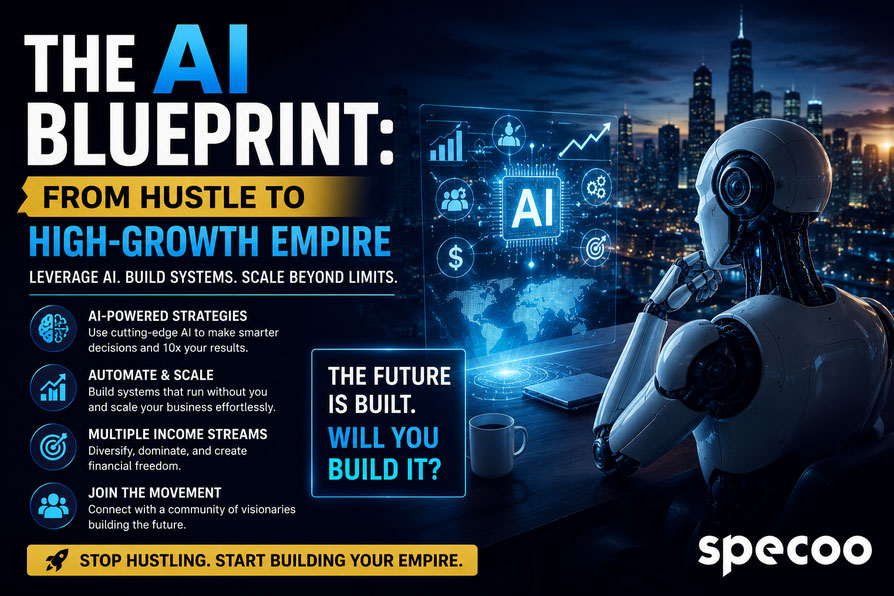
The AI Blueprint: From Hustle to High-Growth Empire
There’s a specific kind of exhaustion that only founders and side-hustlers know. It’s not the tiredness of hard work — it’s the tiredness of hard work that doesn’t compound. You write the caption yourself. You build the funnel yourself. You answer the same customer question for the fortieth time yourself. Revenue goes up, but so does the number of hours required to sustain it. That’s hustle. It has a ceiling, and most people hit it faster than they expect.
What separates a business that stays a hustle from one that becomes an empire isn’t luck, funding, or even talent. Increasingly, it’s systems — and in 2026, the fastest, cheapest, most accessible system-building tool available to any solo operator is artificial intelligence. Not AI as a buzzword. AI as infrastructure: the quiet layer of automation, content generation, and decision support that lets one person operate like a ten-person team.
This piece is a practical blueprint for that shift — what changes, what to build first, and how to tell the difference between businesses that are using AI as a toy and businesses that are using it as a growth engine.
The Hustle Ceiling: Why Grinding Harder Stopped Working
Every founder has heard the advice to “just work harder.” For a while, it’s even true. Early-stage momentum often does come from raw hours — showing up, testing offers, learning the market by hand. But hustle has a mathematical problem: it scales linearly with your time, and your time is fixed at twenty-four hours a day.
The businesses that break through don’t out-hustle everyone else forever. They convert their hustle into repeatable systems before burnout sets in. Historically, that meant hiring — a copywriter, a virtual assistant, an ops manager. Hiring works, but it’s slow, expensive, and risky for a business that hasn’t proven its unit economics yet.
AI changes the sequencing. Instead of hustle → revenue → hires → systems, the new path looks like hustle → AI-assisted systems → revenue → selective hires for the things only humans should do. You no longer need six figures of monthly revenue to justify building a content engine, a customer-response framework, or a competitor-analysis pipeline. You need a laptop and the discipline to build reusable prompts instead of one-off requests.
This is the real story behind adoption numbers that once looked exaggerated. Recent research from the U.S. Chamber of Commerce found that a large majority of small businesses are now using AI in some capacity, a sharp jump from just a few years ago, and Salesforce’s SMB research reports that the overwhelming majority of small businesses using AI say it is directly boosting revenue and operational efficiency. The gap isn’t between big companies and small ones anymore. It’s between operators who treat AI as a novelty and operators who treat it as infrastructure.
What “High-Growth Empire” Actually Means in 2026
“Empire” is a loaded word, and it’s worth defining precisely, because the sales-page version of empire-building (private jets, seven-figure launches, passive income while you sleep) is mostly fantasy. The realistic version is less cinematic and far more useful.
A high-growth empire, in practical terms, is a business where:
- Output no longer scales 1:1 with the founder’s personal hours.
- Core processes — content, customer communication, research, quality control — run on documented systems rather than memory and improvisation.
- The founder’s time is spent on the 20% of decisions that actually require human judgment, while AI-assisted workflows absorb the other 80%.
- Growth compounds because each new system makes the next one easier to build.
None of that requires venture funding or a large team. It requires an operator who has stopped treating every task as a one-time favor to be typed out from scratch, and started treating repeatable tasks as systems to be engineered once and reused indefinitely. That distinction — one-off prompting versus systemized prompting — is the actual hinge point between hustle and empire.
The Four Pillars of the AI Blueprint
Every durable AI-powered business system, regardless of industry, tends to rest on the same four pillars. Skip one, and the system breaks down under real-world use.
1. Automate
Automation is the most obvious pillar and the easiest to get partially right. The mistake most operators make is automating outputs without automating the process that produces them. A single AI-written blog post isn’t automation — it’s a favor. A documented workflow that takes a topic, runs it through research, drafting, editing, and formatting steps automatically is automation. The difference is whether the system survives your absence for a week.
2. Amplify
Amplification is about multiplying the reach of work you’ve already validated. If a piece of content, an email sequence, or a sales script works, AI lets you adapt it across formats, languages, and platforms far faster than a human team could. This is where multimodal capability — the ability of modern models to work across text, images, audio, and video in one workflow — matters most. A single winning asset can become a dozen without a dozen new ideas.
3. Analyze
Most small operators skip this pillar entirely, which is a mistake, because it’s where AI provides asymmetric leverage. Competitor teardown, customer feedback pattern-spotting, A/B test interpretation, and market research that used to take an analyst days can now run in the background continuously. Businesses that build a habit of AI-assisted analysis catch problems and openings weeks before the businesses that don’t.
4. Architect
The final pillar is the one that turns tactics into an empire: architecture. This means deliberately designing how your systems connect — how the output of your research workflow feeds your content workflow, how your content workflow feeds your sales workflow, and so on. A business with four disconnected AI hacks is still a hustle. A business with four AI systems wired together into a pipeline is an empire in miniature.
Hustle Mode vs. Empire Mode: A Side-by-Side Comparison
The table below lays out the practical differences between an operator still running on manual hustle and one who has systemized their workflow using the four pillars above.
| Dimension | Hustle Mode (Manual) | Empire Mode (AI-Systemized) |
|---|---|---|
| Content production | One piece at a time, written from scratch each time | Batched output from reusable prompt templates and workflows |
| Customer response time | Hours to days, dependent on founder availability | Minutes, via AI-assisted drafting and triage |
| Research & competitor tracking | Occasional, manual, easy to neglect | Continuous, automated, reviewed on a schedule |
| Cost to scale output | Roughly linear — more output requires more hours or more hires | Largely flat — the same system produces more without proportional cost |
| Consistency of brand voice | Varies by mood, energy, and time pressure | Encoded into a reusable “brand voice” prompt, applied consistently |
| Founder’s daily focus | Split across dozens of small execution tasks | Concentrated on strategy, judgment calls, and system design |
| Burnout risk | High — growth directly increases personal workload | Lower — growth increases system usage, not personal hours |
| Growth ceiling | Bounded by the founder’s available time | Bounded mainly by strategy and demand, not execution capacity |
The pattern across every row is the same: hustle mode ties growth to personal effort, while empire mode ties growth to system design. That single shift is what the rest of this piece is really about.
The Data Behind the Shift
Skeptics are right to ask whether “AI-powered growth” is marketing language or measurable reality. The honest answer is: the data is genuinely strong, but it’s also inconsistent across studies, mostly because researchers define “AI adoption” differently — some count anyone who has tried a free chatbot once, others only count businesses with a dedicated budget and strategy.
Even accounting for that noise, a few patterns hold up across nearly every credible source:
- Regular AI usage among small businesses has climbed sharply year over year, according to multiple surveys from the U.S. Chamber of Commerce, Intuit QuickBooks, and Salesforce, with adoption now considered mainstream rather than experimental.
- The large majority of small businesses actively using AI report measurable gains in revenue and operational efficiency, rather than just time saved.
- Businesses that have adopted AI are more likely to be in a growth phase than businesses that haven’t, according to comparative research on adoption and business trajectory.
- Content creation, customer service, and administrative work remain the three most common use cases — precisely the categories that eat the most founder hours in an early-stage business.
The consistent theme isn’t that AI is magic. It’s that the businesses treating AI as core infrastructure — not a side experiment — are the ones pulling ahead, and the gap between “explorer” businesses and “systemized” businesses is widening every quarter.
Building Your First Prompt-Powered System
Theory is only useful if it converts into a Monday-morning action list. Here’s a straightforward sequence for building your first real AI system, rather than another one-off prompt you’ll forget by Thursday.
Start with one repeatable task, not your whole business. Pick something you do at least weekly — a content type, a customer response category, a research task. Trying to systemize everything at once is how most attempts stall.
Write the prompt as a reusable template, not a single request. Include the context, the format, the tone, and the constraints every time, structured so you can swap in new details without rewriting the whole thing. This is the difference between a prompt and a prompt system.
Save it somewhere searchable. A prompt that lives in your memory or a random chat thread isn’t a system — it’s a lucky accident. Tools like Notion, dedicated prompt-library features inside Claude Projects, or even a well-organized document turn a one-off win into a reusable asset.
Route the task to the right model for the job. Different frontier models have different strengths — some are stronger on very long documents and context, others are stronger on structured reasoning and multi-step logic. Testing the same prompt across two or three models before committing to one is a habit worth building early.
Add a review step. AI-generated output should rarely go out unreviewed, especially early on. Build a five-minute human check into the workflow rather than skipping it — this is what keeps quality high as volume increases.
Track what works and prune what doesn’t. A prompt library only becomes valuable when you treat it like a product: version it, retire what underperforms, and keep refining the templates that consistently deliver.
Do this for even ten tasks over a month, and the compounding effect becomes obvious. You’re not just saving time on each task — you’re building a growing library of institutional knowledge that gets more valuable every time you use it.
Where a Ready-Made Playbook Fits In
Building all of this from scratch is entirely doable, but it takes trial and error — and time is the one resource a growing business rarely has to spare. That’s the gap that structured guides exist to close.
One resource worth knowing about is The AI Blueprint: From Hustle to High-Growth Empire, a digital playbook from LevelAIght built specifically around this pillar structure — prompt engineering, prompt libraries, model routing, and multimodal workflows for entrepreneurs, marketers, and creators. It walks through a “prompting maturity” progression from basic one-shot requests up to more autonomous, agentic workflows, and includes templates for the kind of reusable systems described above: brand-voice prompts, competitor teardown frameworks, and multilingual content patterns.
A few practical details worth knowing before clicking through: it’s a downloadable PDF (roughly 10MB), delivered instantly after purchase, sold as a one-time payment with no recurring billing, and it’s currently discounted from its $99 list price — check the checkout page for the exact live price, since promotional pricing changes. As with any business or income-related guide, treat the efficiency and revenue figures mentioned on the sales page as claims from the publisher rather than guarantees — actual results depend heavily on your niche, effort, and execution.
Disclosure: the link above is an affiliate link. If you purchase through it, this publisher may earn a commission at no extra cost to you.
Trusted Resources for Going Deeper
No single guide, including this article, should be your only input. Here are credible, freely available places to keep learning and to cross-check any AI-business claim you come across, including the ones in this piece:
- Anthropic — documentation, safety research, and practical guidance on using Claude models for business workflows.
- OpenAI — model releases, usage guides, and applied case studies.
- Google AI — research and product updates across Google’s AI ecosystem, including Gemini.
- Salesforce — regularly publishes SMB-focused AI adoption and ROI research.
- U.S. Chamber of Commerce — publishes some of the most cited small-business AI adoption surveys.
- Deloitte Insights — enterprise and SMB AI adoption reporting, updated regularly.
- HubSpot — practical marketing and content-automation guides geared toward small teams.
- Notion — a common home base for building and organizing a searchable prompt library.
Frequently Asked Questions
Is AI actually necessary to grow a small business, or is it hype? It’s not strictly necessary — businesses grew long before generative AI existed — but the data consistently shows that businesses using it well are growing faster and more efficiently than those that aren’t. Treating it as optional in 2026 means competing with one hand tied behind your back.
What’s the fastest way to start if I’ve never used AI for business tasks? Pick one repeatable task you already do weekly, build a reusable prompt template for it, save it somewhere searchable, and use it for a month before adding a second system. Breadth too early is the most common failure mode.
Do I need to pay for a premium AI tool to see results? No. Free tiers of major models are enough to start building real systems. Paid tools matter more once you’re running high volume or need longer context windows, not on day one.
How is “prompt engineering” different from just chatting with an AI tool? Chatting is improvised and disappears after the conversation. Prompt engineering means designing structured, reusable templates — with consistent context, tone, and format — that produce reliable output every time you use them, turning a one-off interaction into a system.
Is a paid guide like The AI Blueprint worth it over free tutorials? That depends on how you value your time. Free tutorials exist, but they’re scattered and inconsistent. A structured, single-source playbook can save the hours you’d otherwise spend piecing together a system from blog posts and videos — though the fundamentals in this article will get you started either way.
The Bottom Line
The gap between a hustle and an empire was never really about hustle harder. It was about the point where a founder stops trading hours for output and starts trading system design for output. AI has simply lowered the cost of building that second kind of business to nearly zero — a laptop, some discipline, and a willingness to document what already works.
The data backs it up, the tools are more accessible than they’ve ever been, and the operators pulling ahead right now aren’t necessarily smarter or better funded. They’re the ones who treated their first good prompt as the start of a system, instead of a lucky one-off. Build the system once. Let it compound. That’s the blueprint.
Related Posts