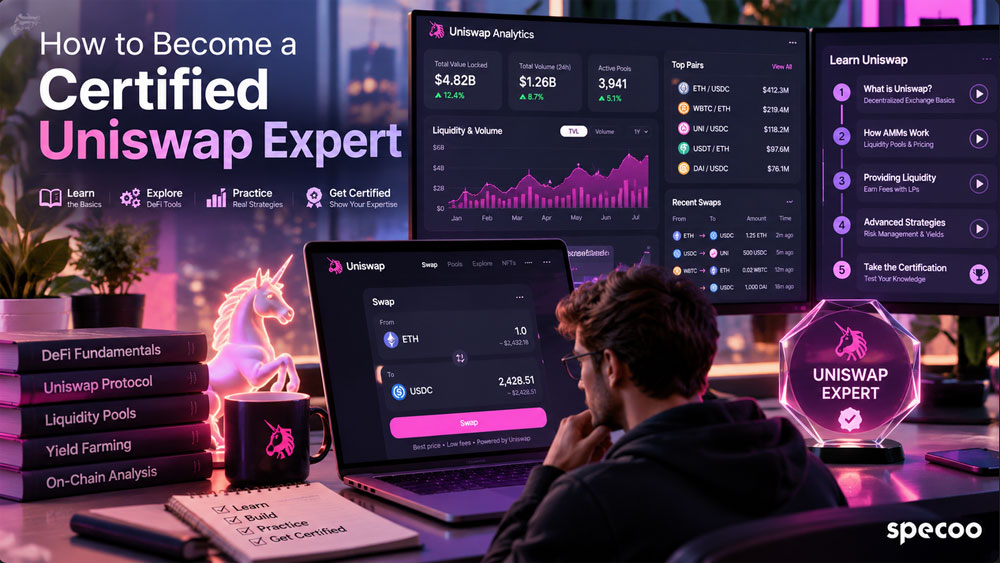
How to Become a Certified Uniswap Expert: A Practical Roadmap for 2026
- specoo
- October 3, 2026
- Blockchain, Cryptocurrency
Uniswap started as a side project by Hayden Adams in 2018, and it has become one of the foundations of decentralized finance. It processes enormous trading volume, has gone through four major protocol versions, and has shaped how nearly every other automated market maker (AMM) is built. Hiring managers, DAOs, and protocol teams now look for people who understand it properly, not people who have only clicked “Swap” a few times.
A credential in this niche is worth having only when it’s backed by real understanding. This guide covers what “Uniswap expert” means in practice, how the Blockchain Council certification fits in, which skills to build, and how to prove them on-chain.
What “Uniswap Expert” Actually Means
The label covers three different people:
- The analyst reads pool data, understands fee tiers, and can explain why a liquidity position lost money even though the token price barely moved.
- The builder writes Solidity or TypeScript that interacts with Uniswap contracts, from simple swap integrations to custom V4 hooks.
- The strategist designs liquidity provision strategies, manages impermanent loss, and advises treasuries or DAOs on market-making.
Most people begin as one of these and grow into a second. A certification gives you a structured way to cover the shared foundation before you specialize.
Why the Certification Route Makes Sense
Self-study is free and effective, but it has a cost: no one tells you what you’ve missed. DeFi knowledge is full of gaps. You can learn the constant product formula and never hear about the mechanics of fee accrual, or build a swap UI without understanding what the router does with slippage limits.
A certification offers:
- A defined curriculum. Someone has decided what the baseline looks like.
- A verifiable credential. It can go on a résumé, LinkedIn profile, or freelance pitch.
- A forcing function. An exam with a pass mark makes you consolidate what you’ve read.
Neither route replaces the other. The strongest candidates combine both, a structured credential and a public record of work.
The Certified Uniswap Expert™ Program at Blockchain Council
The most visible credential in this niche is the Certified Uniswap Expert™ (CUE) from Blockchain Council. The product page for the program is at https://www.blockchain-council.org/certifications/certified-uniswap-expert/.
Who it’s designed for
Blockchain Council positions the certification for blockchain experts, developers, architects, consultants, smart contract developers, and Uniswap consultants. It is not restricted to engineers, and the entry requirements reflect that. Candidates are expected to know the fundamentals of blockchain technology, and some familiarity with Ethereum helps.
What the curriculum covers
The module outline, as listed on a training partner’s course page, follows a logical progression:
- An Ethereum blockchain overview, followed by what Uniswap is, why it’s popular, and whether it’s safe
- How Uniswap works, including arbitrage, removing liquidity, how the protocol makes money, the UNI token, wallets, and staking
- A comparison of Uniswap with Sushiswap, a fork of Uniswap
- Uniswap versions V1, V2, and V3
- Integrations such as Aave and Instadapp with Uniswap, plus a module on the risks of trading on Uniswap
The listed outline stops at V3, while Uniswap has since released V4. Treat the certification as a foundation and plan to cover V4 on your own. The later sections of this guide show how.
Exam format
According to Blockchain Council’s exam page:
- The exam is an online multiple-choice test of 100 marks, taken after the training.
- A score of 60% or higher is needed to pass.
- A failed attempt can be retaken after one day, up to a maximum of three times.
Time and cost
Listings differ, so check the current product page before paying. The academy listing describes about 4 hours of self-paced online training plus a 1-hour exam, with an exam-only option at $199. Structured data on another Blockchain Council page lists a 12-hour time requirement and the same $199 price. These pages were indexed at different times, which likely explains the mismatch. Confirm duration and price on the live page.
A Step-by-Step Plan to Get Certified
Step 1: Build the Ethereum foundation
You can’t understand Uniswap without understanding the chain it runs on. Before touching any DeFi material, make sure you’re comfortable with:
- Accounts, transactions, and gas
- How smart contracts store state and emit events
- What ERC-20 tokens are, including
approveandtransferFrom - How wrapped ETH (WETH) works and why AMMs need it
The Ethereum developer documentation is the best free starting point. Try the Etherscan block explorer early and often. Reading real transactions teaches faster than any diagram.
Step 2: Learn the AMM idea from first principles
Traditional exchanges match buyers with sellers through an order book. Uniswap replaced that with a pool of two assets and a pricing rule. The V1 and V2 rule is the constant product formula:
x × y = k
If a pool holds 100 ETH and 300,000 USDC, then k is 30,000,000. A trader who buys ETH removes some from the pool and adds USDC. The product must remain constant, so the price moves along a curve. Larger trades move the price more, which is slippage.
Work through the arithmetic by hand a few times:
- How much USDC is needed to withdraw 1 ETH from that pool?
- What’s the effective price versus the starting price?
- How does the 0.3% fee change the result?
Once those numbers feel natural, the rest of the protocol follows.
Step 3: Understand liquidity provision and impermanent loss
Liquidity providers (LPs) deposit both assets into a pool and earn a share of trading fees. In return, they take on impermanent loss, the difference between holding the pair in a pool and simply holding the tokens. When the relative price of the two assets diverges, the pool rebalances against the LP.
This is the topic where beginners and experts separate. A beginner says “I earned 40% APR.” An expert asks, “40% denominated in what, after impermanent loss, after gas, and compared with just holding?”
Step 4: Study each version of the protocol
Each Uniswap release changed what’s possible:
| Version | Launched | Defining idea |
|---|---|---|
| V1 | 2018 | ETH-to-token pools, a proof that on-chain AMMs work |
| V2 | 2020 | Direct ERC-20 pairs, price oracles, flash swaps |
| V3 | 2021 | Concentrated liquidity and multiple fee tiers |
| V4 | 2025 | Hooks, a singleton pool manager, flash accounting, native ETH |
V3 is the version most people find hardest. Instead of spreading liquidity across every possible price, LPs choose a range. Capital works harder inside that range and earns nothing outside it. V3 introduced fee tiers (0.01%, 0.05%, 0.3%, and 1%) and represents positions as NFTs.
V4 keeps concentrated liquidity but changes the architecture. All pools live in a single contract, and developers can attach hooks, custom code that runs at defined points in a pool’s lifecycle. This is where a lot of current builder activity happens, so it deserves real time even though entry-level certification outlines emphasize earlier versions.
The original papers remain the clearest explanations: the V2 whitepaper and the V3 whitepaper are short and readable.
Step 5: Enroll, study, and sit the exam
With the foundation in place, the Blockchain Council material works as a structured review instead of a cold start. Enroll through the Certified Uniswap Expert™ product page or directly on the Blockchain Council certification page. Then:
- Go through all modules once at normal speed.
- Go back through the ones that felt shaky, especially versions and risks.
- Write your own summary of how a swap executes from click to settlement.
- Take the exam when you can explain each module without looking at it.
The 60% pass mark is reachable for a prepared candidate, and the retake policy lowers the stakes.
Step 6: Turn the credential into proof
A certificate says you studied. A portfolio says you can do the work. The next section explains how to build one.
Contract Addresses Every Uniswap Expert Should Recognize
An expert doesn’t need to memorize hexadecimal strings, but should know where to look and what each core contract does. The addresses below are for Ethereum mainnet. Always confirm them against the official Uniswap deployment docs before sending any transaction, because addresses differ by chain and mistakes on-chain are expensive.
| Contract | Role | Ethereum mainnet address |
|---|---|---|
| UNI token | Governance token | 0x1f9840a85d5aF5bf1D1762F925BDADdC4201F984 |
| V2 Factory | Creates and tracks V2 pairs | 0x5C69bEe701ef814a2B6a3EDD4B1652CB9cc5aA6f |
| V2 Router02 | Routes swaps and liquidity actions in V2 | 0x7a250d5630B4cF539739dF2C5dAcb4c659F2488D |
| V3 Factory | Deploys V3 pools | 0x1F98431c8aD98523631AE4a59f267346ea31F984 |
| V3 NonfungiblePositionManager | Mints and manages V3 position NFTs | 0xC36442b4a4522E871399CD717aBDD847Ab11FE88 |
| SwapRouter02 | Swap routing for V2 and V3 | 0x68b3465833fb72A70ecDF485E0e4C7bD8665Fc45 |
| Permit2 | Shared token approval contract | 0x000000000022D473030F116dDEE9F6B43aC78BA3 |
| V4 PoolManager | Singleton holding all V4 pools | 0x000000000004444c5dc75cB358380D2e3dE08A90 |
| WETH9 | Wrapped ETH used across pools | 0xC02aaA39b223FE8D0A0e5C4F27eAD9083C756Cc2 |
Open each one on Etherscan, click the Contract tab, and read the verified source. Reading real code is one of the fastest ways to move from user to expert.
Web addresses worth bookmarking
- Trading interface: app.uniswap.org
- Developer documentation: docs.uniswap.org
- Source code: github.com/Uniswap
- Governance forum: gov.uniswap.org
- Ecosystem grants and research: uniswapfoundation.org
- On-chain analytics: dune.com
Comparison Table: Ways to Build Uniswap Expertise
No single route is best for everyone. This table compares the main options so you can choose one or combine them.
| Route | Format | Best for | Cost | What you walk away with | Main limitation |
|---|---|---|---|---|---|
| Certified Uniswap Expert™ (Blockchain Council) | Self-paced online training plus MCQ exam | Beginners, analysts, consultants, career switchers needing a credential | Paid; check the live page | A recognized certificate and a structured foundation | Listed modules end at V3; hands-on coding is limited |
| Official docs and whitepapers (docs.uniswap.org) | Self-directed reading | Developers who prefer primary sources | Free | Deep, accurate protocol knowledge | No assessment or credential |
| Reading and forking code (GitHub) | Hands-on code study | Solidity developers | Free | Real understanding of contract internals | Steep learning curve without guidance |
| Smart contract security courses (e.g. Cyfrin Updraft) | Video-led developer courses | Builders moving into auditing or protocol work | Free to low cost | Solidity and security skills that transfer to AMMs | Not Uniswap-specific |
| Live LP positions on testnet or small mainnet amounts | Practical experiment | Strategists and analysts | Gas plus capital at risk | First-hand experience of fees and impermanent loss | Real financial risk if you use mainnet |
| Hackathons, grants, and hook-building programs | Competitive or mentored projects | Experienced builders | Usually free | Public portfolio and community connections | Time-intensive and competitive |
The first row gives you the credential and the vocabulary. The rest give you proof. A candidate who combines the certificate with one public project is far more convincing than someone who has only one of the two.
Skills That Separate Certified From Competent
Reading pool data without being fooled by it
Dashboards show total value locked (TVL), volume, and fees. A strong analyst asks harder questions:
- Is the volume organic, or is one bot cycling the same funds?
- Does the fee tier match the pair’s volatility? A stablecoin pair on a 1% tier is suspicious, and an exotic token on 0.01% is under-compensating LPs.
- Is liquidity concentrated near the current price, or stranded far away?
Build a Dune dashboard of your own for a pool you care about. It’s a strong portfolio piece.
Understanding slippage, price impact, and MEV
Uniswap trades are public before they confirm. Searchers can see a pending swap and trade around it, a practice known as sandwiching. Experts know how to reduce exposure by setting tight slippage tolerances, using private transaction routes, and choosing the right routing. This knowledge matters whether you build interfaces or manage a treasury.
Thinking in risks, not just yields
The Blockchain Council curriculum includes a dedicated module on trading risks, and the topic deserves it. The main categories are:
- Impermanent loss, which is structural and unavoidable.
- Smart contract risk, which is low for audited core contracts but high for forks and new hooks.
- Token risk, meaning scam tokens with fake liquidity or malicious transfer logic.
- Approval risk, since unlimited token approvals to unknown contracts are a common loss vector.
- Front-end and phishing risk, because cloned websites steal funds.
Knowing how governance works
Uniswap is governed by UNI holders. Proposals are discussed on the governance forum and voted on through on-chain mechanisms. Questions such as fee distribution, deployment on new chains, and grants all flow through this process. Following a few proposals from discussion to execution teaches you more about how protocols evolve than any textbook.
Building a Portfolio That Backs Up the Certificate
Pick two or three of these projects and publish them on GitHub with a clear README:
- A swap price calculator. Implement the constant product formula with fees and slippage, then compare your output with the live quote.
- An impermanent loss visualizer. Let users enter a price change and see the loss relative to holding. Do it for both V2 and a V3 range.
- A pool analytics dashboard. Use Dune queries to show volume, fees, and LP concentration for a pair.
- A simple V3 integration. Use the official SDK or contracts to fetch quotes and execute a swap on a testnet.
- A minimal V4 hook. Even a basic hook that logs swaps or adjusts a fee shows you understand the new architecture.
- A written case study. Analyze one LP position’s performance over a month and explain every line of profit and loss.
Writing counts as much as code. A clear explanation of why a position lost money shows analytical thinking that employers value.
Where Certified Uniswap Experts Find Work
The credential and skills apply across several roles:
- DeFi analyst or researcher at funds, data firms, and protocol teams
- Smart contract developer at wallets, aggregators, and DeFi projects building on Uniswap liquidity
- Liquidity manager or market maker for token projects and DAO treasuries
- Protocol integration engineer connecting Uniswap to lending platforms, vaults, and trading bots
- Consultant or educator helping traditional finance firms understand DeFi
- Community and governance contributor working with delegates and grant programs
The Blockchain Council program itself lists target roles including blockchain expert, developer, architect, consultant, and financial analyst. The training partner page names Blockchain Expert, Blockchain Developer, Blockchain Architect, Blockchain Consultant, and Blockchain Financial Analyst.
For job hunting, put the certification near the top of your profile, link your GitHub and your Dune dashboards, and write one sentence in your own words about what you can do with Uniswap. Specific claims beat vague ones. “I model LP returns across fee tiers” is stronger than “DeFi enthusiast.”
Common Mistakes to Avoid
Treating the certificate as the finish line. The exam checks foundational knowledge. The protocol keeps changing, and experts keep reading release notes and governance proposals.
Skipping the math. Plenty of people can describe impermanent loss in words and still can’t calculate it. Do the arithmetic.
Ignoring V4. Given the pace of the ecosystem, learning only V1 through V3 leaves you behind. Read the V4 docs once you’ve finished the certification material.
Testing with real money too early. Use a testnet first, then small mainnet amounts you can afford to lose. Check every contract address twice.
Trusting unofficial links. Phishing sites copy Uniswap’s interface precisely. Reach the app only through bookmarks you set yourself or the official domain.
Confusing yield with profit. A high APR on a volatile pair can still be a net loss after price divergence.
A Realistic Timeline
For someone with basic crypto familiarity and no coding background:
- Weeks 1–2: Ethereum fundamentals, wallets, ERC-20 tokens, Etherscan practice.
- Weeks 3–4: AMM math, impermanent loss, V2 mechanics, whitepaper reading.
- Weeks 5–6: V3 concentrated liquidity, fee tiers, and the V4 overview.
- Week 7: Blockchain Council modules, review, and exam.
- Weeks 8–12: Portfolio projects, governance reading, and job or freelance outreach.
Developers with Solidity experience can compress the first four weeks considerably and spend the extra time on contract reading and hook experiments.
Frequently Asked Questions
Is the Certified Uniswap Expert™ certification worth it?
It’s worth it if you want a structured foundation and a credential to show employers or clients, particularly if you’re moving into DeFi from another field. It’s less valuable on its own for senior engineering roles, where public code carries more weight.
Do I need to know how to code?
The Blockchain Council entry requirements emphasize blockchain fundamentals and Ethereum familiarity, not programming. Coding becomes essential if you want to build integrations or hooks.
What score do I need to pass?
The exam requires 60% or more, with retakes allowed after one day, up to three attempts.
How much does it cost?
Listings have shown an exam-only price of $199. Prices change, so check the product page for current terms.
Does the certification cover Uniswap V4?
The published module outline reaches V3. Plan to study V4 separately through the official documentation.
Can I become an expert without any certificate?
Yes. Many practitioners are self-taught. The certificate adds structure and a verifiable credential, and it works best alongside real projects.
Final Thoughts
Becoming a Certified Uniswap Expert is a sequence of small, concrete steps: learn the chain, learn the math, learn each protocol version, pass the exam, and then prove the knowledge in public. The certification is a useful milestone in that sequence, and the work you publish afterward is what makes it count.
Start by reading the Certified Uniswap Expert™ program details, open the Uniswap docs in another tab, and pull up a real pool on Etherscan. Within a few hours you’ll know whether this field suits you, and every week after that makes the next one easier.
Disclaimer: This article is educational and not financial advice. Contract addresses can change or differ by network, so verify every address against official Uniswap documentation before interacting with it. Course details, duration, and pricing come from third-party listings and may have changed,
Related Posts