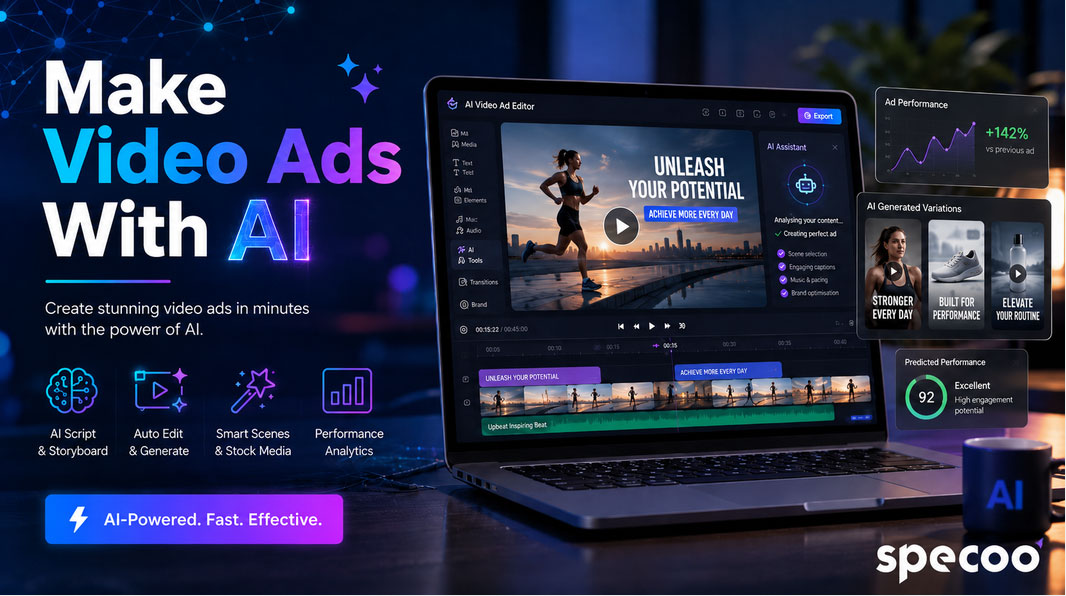
Make Video Ads With AI: The New Rules of Advertising Production
- specoo
- August 29, 2026
- Affiliate Marketing, AI
There was a time, not long ago, when a single video ad meant a production company, a shot list, a rented studio, a voiceover artist on retainer, and a bill that started at four figures and climbed from there. That world hasn’t disappeared entirely, but it has stopped being the only option. It has, for a large and growing share of marketers, stopped being the default option at all.
The AI video marketing market grew from roughly $5.1 billion in 2023 to about $18.6 billion in 2026, expanding at a compound annual growth rate above 34%. Marketing teams are the ones spending it, and they’re spending at scale: business adoption of AI video jumped from 18% in 2023 to 41% by 2025, and 63% of video marketers now say they’ve used AI tools to help create or edit video. That’s up from 51% just one reporting cycle earlier — the fastest single-year jump anyone tracking the category has recorded. Global AI-generated video ad spend is projected to hit $9.1 billion in 2026, or roughly one out of every eight dollars spent on digital video advertising.
None of that is a prediction anymore. It’s a description of what’s already happening in the accounts of small e-commerce brands, real estate agencies, SaaS companies, and solo affiliate marketers who, three years ago, wouldn’t have touched video because it was too expensive, too slow, or too dependent on someone else’s calendar.
This piece is about how that shift actually works in practice — what “making a video ad with AI” really means today, which tools do what, where the process still needs a human hand, and how to avoid the two failure modes that trip up almost everyone new to this: ads that look obviously synthetic, and ads that are technically polished but say nothing anyone wants to hear.
What “AI Video Ad” Actually Means in 2026
The phrase gets used loosely, so it’s worth being precise. An AI-made video ad is usually the product of several distinct AI systems working in sequence, not one magic button. Understanding the layers makes the tools easier to evaluate.
Script and hook generation. A language model turns a product description, a URL, or a rough idea into a structured ad script — hook, problem, solution, proof, call to action. This is the layer that decides whether the first three seconds earn a second look.
Visual generation. This is the part most people picture first: text-to-video models that generate scenes from a prompt, AI avatars that deliver a script on camera without a human ever standing in front of a lens, or tools that animate a single product photo into a moving shot with camera pans, lighting changes, and depth.
Voice and audio. Text-to-speech has moved well past the robotic monotone stage. Modern voice models carry emphasis, pacing, and emotional tone, and several platforms now let you clone a real voice — yours or a client’s — from a short sample.
Editing and repurposing. Once the raw footage exists, AI handles the cutting: captions synced to speech, pacing adjusted for platform (a 30-second TikTok cut differs from a 15-second Reels cut), and thumbnails generated automatically from the video content.
Analysis and cloning. The newest and arguably most useful layer: AI that watches an already-successful ad — one racking up views on Facebook or TikTok right now — and reverse-engineers why it works, breaking down the hook structure, shot timing, and script pattern so that formula can be rebuilt around a different product.
That last layer matters more than it sounds. Most of the failure in video advertising was never really a production problem. It was a guessing problem — spending money to find out, after the fact, whether an angle resonated. AI collapses that guesswork because it can study thousands of live ads and extract the pattern in seconds instead of weeks.
The Case for Doing This Now
Three numbers explain why this shift accelerated so fast. AI tools are cutting production costs by up to 91% and reducing production time by 50–80% compared to traditional shoots. Where a 60-second marketing video used to take roughly two weeks from brief to delivery, some AI-assisted workflows now produce a comparable video in well under an hour. And on performance, AI-personalized video ads are landing click-through rates in the 6–7% range against a roughly 2% benchmark for generic creative, while teams using AI are shipping up to 11 times more video content per month than they were before.
Put those together and the strategic shift becomes obvious: video advertising used to reward whoever could afford the biggest production budget. It’s starting to reward whoever can test the most variations fastest. A brand that can produce and publish twenty ad variants in a week has a structural advantage over one still waiting on a single polished cut from an agency — not because the twenty are individually better, but because more shots at the target means faster discovery of what actually works.
Short, vertical, and fast is also simply where the audience already is. Short-form video ad spend alone is approaching $111 billion, close to half of all video ad spend globally, and the majority of it is watched vertically on a phone. If your ad isn’t built for that format from the start, no amount of production value fixes it after the fact.
The Actual Workflow: From Idea to Published Ad
Strip away the marketing language around individual tools and the process almost every AI-driven video ad workflow follows looks like this.
Step 1 — Find something that’s already working
Rather than starting from a blank page, the more reliable starting point is a live example: an ad currently getting real engagement in your category, on Facebook, TikTok, or Instagram. Ad libraries make this easy to browse directly — Meta’s Ad Library is free and shows every ad currently running across Facebook and Instagram, searchable by brand, keyword, or region. Some newer AI platforms fold this step directly into the tool, surfacing top-performing ads in your niche automatically instead of making you scroll and screenshot.
Step 2 — Break down why it works
This is where AI earns its keep as an analyst, not just a generator. Feed a winning video into an analysis tool and it will return a structured breakdown: the hook in the first 1–3 seconds, the pacing of each scene, the script’s persuasion pattern (problem-agitate-solve, before-after-bridge, social proof stacking), and the audio cues. What used to take a media buyer an hour of frame-by-frame study now takes under a minute.
Step 3 — Generate your version
With the formula identified, generation tools rebuild it around your product. Depending on the platform, this might mean an AI avatar delivering the script on camera, a cinematic sequence built from product photos, or a fully synthetic scene generated from a text prompt. The output keeps the winning structure — the same hook rhythm, the same pacing — while swapping in your brand, your offer, and your proof points.
Step 4 — Add voice, music, and captions
Voiceover and music used to be separate line items with separate vendors and separate turnaround times. AI voice studios now offer dozens of professional voice options with real emotional range, plus voice cloning for a consistent brand voice across every ad. Royalty-free AI-generated music removes the licensing headache entirely, and auto-captioning matters more than it might seem — most video is watched with the sound off, so captions aren’t a nice-to-have, they’re load-bearing.
Step 5 — Cut it for every platform, not just one
A script built for a 30-second TikTok doesn’t automatically work as a 15-second Reel or a 6-second YouTube bumper. The final AI layer reformats a single piece of source content into the aspect ratios, lengths, and pacing each platform’s algorithm actually rewards, turning one production into a dozen deployable assets.
Tools Worth Actually Knowing About
The category is crowded, and most comparison lists online are thinly disguised affiliate spam. Here’s a more honest map of what different tools are actually built for.
Synthesia — one of the most established AI avatar platforms, strong for corporate explainer and training-style video, with a large library of presenter avatars and multilingual voiceover.
HeyGen — similar territory to Synthesia but leans harder into realism and voice cloning, popular for UGC-style talking-head ads.
Pictory — built around turning long-form content (a blog post, a script, a webinar recording) into short branded video, useful for content repurposing rather than from-scratch ad generation.
InVideo — a template-driven editor with AI scripting layered on top, a reasonable entry point if you want more manual control over the final cut.
Runway — generative video at the more experimental, cinematic end of the spectrum; strong for brands wanting a distinctive visual look rather than a templated ad format.
CapCut — free, mobile-first, and genuinely good for fast UGC-style editing, captioning, and trend-matching, especially for TikTok and Reels.
Descript — edits video by editing a text transcript, which makes cutting a talking-head ad down to its best moments almost as easy as editing a document.
AI Media Machine — the outlier on this list in that it bundles most of the above categories — ad analysis, avatar generation, voice cloning, music, thumbnails, and script-to-video — into a single lifetime-access platform rather than a stack of separate monthly subscriptions. Built by BlueFX, a video-template company operating since 2008, it centers on the “clone and rebuild” workflow described above: you find a winning ad, the tool breaks it down shot by shot, then rebuilds the format around your own product. It’s aimed less at agencies wanting granular creative control and more at solo marketers, affiliates, and small business owners who want the entire production pipeline — finding, cloning, generating, voicing, and publishing — under one roof and one payment, rather than juggling four or five separate tool subscriptions that each do one piece of the job.
Most people land on one of two setups: a single all-in-one platform that covers the whole pipeline, or a small stack of specialized tools stitched together with manual export-import steps in between. Neither is objectively correct — it depends on whether you’d rather pay for convenience or for control.
Quick disclosure: some links in this piece, including the one above, are affiliate links, meaning a purchase through them may earn a commission at no extra cost to you. That’s worth knowing, though it doesn’t change the honest assessment of what each tool is actually good at.
What AI Still Can’t Do For You
None of this replaces judgment, and the tools that oversell themselves as fully automatic tend to produce the flattest, most forgettable ads on the internet. A few things remain stubbornly human.
The offer still has to be good. AI can rebuild the structure of a winning ad in minutes, but it can’t manufacture product-market fit. A perfectly cloned hook selling a mediocre product still sells a mediocre product, just faster and to more people who won’t come back.
Authenticity reads through the screen. UGC-style ads — the ones that look like a real customer talking to a phone camera, not a polished commercial — consistently outperform highly produced creative. Ads featuring genuine user-generated content see roughly 4x higher click-through rates and about 50% lower cost-per-click than typical branded ads, and 92% of consumers say they trust UGC more than traditional advertising. AI avatars and generated footage can approximate that texture, but the ones that convert best are usually the ones edited to feel imperfect on purpose — a slight pause, an off-center frame, captions that look handwritten rather than corporate.
Someone still has to know the audience. AI can tell you what worked for a competitor’s ad. It can’t tell you which objection your specific customer is actually stuck on, or which proof point will land with a skeptical buyer versus an impulsive one. That reading of the room is still a marketing skill, not a prompt.
Compliance and platform rules don’t bend for AI. Meta, TikTok, and Google all have policies around AI-generated and synthetic media disclosure that are actively evolving. An ad that gets flagged or rejected for undisclosed synthetic content wastes exactly as much time as a bad manual shoot, just after the fact instead of before.
A Short Checklist Before You Publish
Before an AI-generated ad goes live, it’s worth running it through a few quick filters that catch most of the common mistakes:
- Does the hook say something specific in the first two seconds, or just something generic and pretty?
- Would this ad make sense with the sound completely off?
- Is there a real, checkable claim or proof point, not just an adjective-heavy pitch?
- Does the pacing match the platform it’s going on, or was it built for a different format and just resized?
- Is there a single, unambiguous next action for the viewer to take?
- If the video uses a synthetic voice or avatar, does it comply with the ad platform’s current disclosure requirements?
Ads that fail two or more of these checks are usually the ones that get made fast, look fine in isolation, and then quietly underperform in the account without anyone quite knowing why.
Where This Is Actually Heading
The interesting part of this shift isn’t that video got cheaper. Cheaper video has been possible for years with stock footage and templates. What changed is that the feedback loop got faster. A team that used to run one creative test per week can now run five per day, because the cost of generating a new variant dropped from hundreds of dollars and days of turnaround to a few dollars and a few minutes.
That changes what a good marketer’s job actually looks like. Less time spent managing production logistics, briefing freelancers, and waiting for delivery. More time spent reading performance data, deciding which angle to test next, and knowing which winning pattern is worth cloning in the first place. The tools handle the execution. The strategy — what to say, to whom, and why it matters — is still entirely a human call, and it’s the part that’s actually getting more valuable, not less, as production stops being the bottleneck.
For businesses that have been sitting out video advertising because of cost or complexity, that bottleneck is mostly gone now. The remaining question isn’t whether AI can make the video. It’s whether you know what to say once it can.
Frequently Asked Questions
Do I need any video editing experience to make AI video ads? No. Most current platforms are built around typing a product description or pasting a URL, not manual timeline editing. Some manual polish still helps, but it’s optional rather than required.
Are AI-generated video ads allowed on Facebook, TikTok, and Google Ads? Yes, with disclosure requirements that vary by platform and are still evolving. Check each platform’s current synthetic media policy before launch, since the rules have changed multiple times over the past two years.
How much does it cost to make a video ad with AI compared to traditional production? Traditional video production for a single ad often runs from several hundred to several thousand dollars. AI-based production typically runs from free (with limited tools) to roughly $30–$100 per month for a capable individual subscription, or a one-time cost for bundled, lifetime-access platforms.
What’s the biggest mistake people make with AI video ads? Treating AI as a shortcut to skip strategy rather than a shortcut to skip production. An ad with no clear hook, offer, or audience insight will underperform no matter how polished the AI-generated footage looks.
Can AI clone a competitor’s exact ad legally? AI tools analyze the structure of a winning ad — pacing, hook pattern, script formula — and rebuild it with your own product, script, and footage. Copying someone else’s actual footage, voice, or copyrighted script word-for-word is a different matter and carries real legal risk regardless of what tool is used to do it.
Related Posts