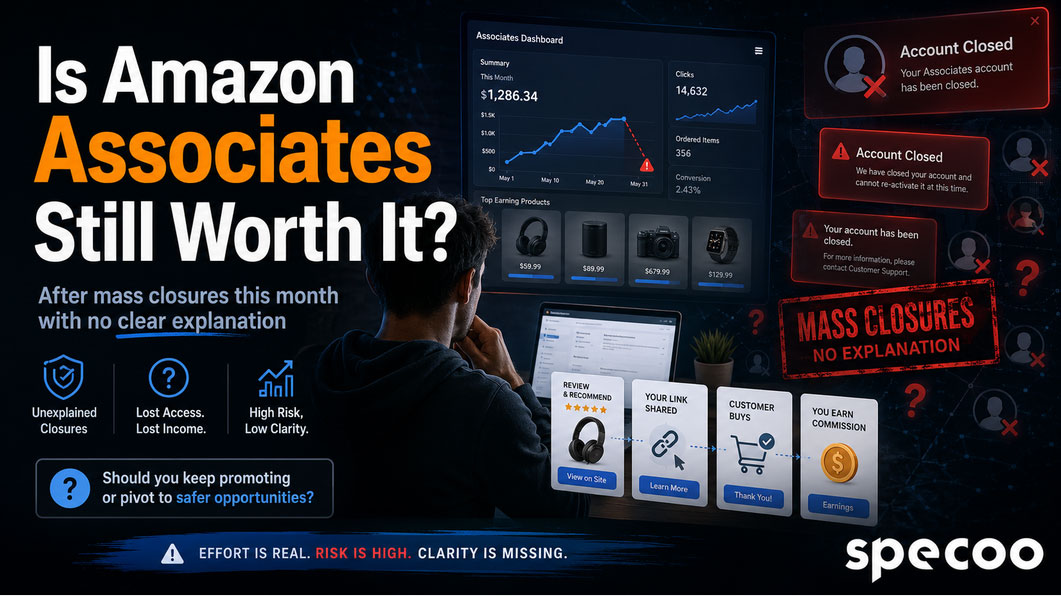
Is It Still Worth Promoting Amazon Associates After This Month’s Mass Closures?
- specoo
- August 29, 2026
- Affiliate Marketing
Something has been rattling the affiliate marketing world lately, and it isn’t a new competitor or a slow news cycle. It’s Amazon itself. Publishers who built entire businesses around Amazon links have been logging into their dashboards this month to find a single line: account closed. No warning email with a clear reason. No specific policy citation. No appeal window that actually leads anywhere. Just a locked account, a frozen balance, and a support ticket that goes nowhere.
If you run a niche site, a YouTube channel, a newsletter, or a Pinterest board stuffed with Amazon links, you’ve probably felt a jolt of anxiety reading this. The question on everyone’s mind isn’t abstract anymore — it’s financial. Should you keep building on a platform that can pull the rug out with zero notice? Or is this the year Amazon Associates stops being a foundation and becomes just one more line item in a diversified income strategy?
This piece digs into what’s actually happening, why it’s happening now, and — more importantly — whether promoting Amazon Associates still makes business sense in the current climate.
What’s Actually Happening With These Closures
Affiliate forums, Reddit threads, and marketing Slack groups have been filling up with near-identical stories. A publisher with years of clean standing, consistent traffic, and no policy violations on record wakes up to a termination notice. The email is generic. It references “non-compliance with the Operating Agreement” without naming a single violation. When the affiliate appeals, they either get silence or a canned response that repeats the same vague language.
This pattern isn’t brand new — Amazon has quietly closed accounts for years, often citing “connected account” violations or unclear traffic-source concerns. What’s different this time is the volume and the timing. Multiple publishers, unconnected to each other, are reporting closures within the same short window, which is exactly the kind of pattern that makes people suspect a policy sweep rather than individual enforcement actions.
This Wave Didn’t Come Out of Nowhere
To understand why this month feels different, it helps to zoom out to what Amazon has done to the Associates program over the past several months, because the closures aren’t happening in isolation — they’re the latest chapter in a much bigger rewrite of the rules.
A Quietly Rewritten Operating Agreement
Amazon updated its Associates Program Operating Agreement with an effective date of April 14, 2026. There was no press release, no blog post, no proactive email campaign explaining the shift in plain language. Publishers found out because trade outlets like Adweek started reporting on it, and other industry publications picked up the thread afterward. One of the most consequential changes buried in that update narrowed what’s known as “halo” commissions — the practice of earning a cut on unrelated items a shopper added to their cart after clicking your link. Under the new terms, that halo effect is far more restricted, tied more tightly to the same product a visitor actually clicked through to.
Rate Cuts Nobody Announced Either
Layered on top of the agreement rewrite, several outlets — again starting with trade press rather than Amazon itself — reported commission rate reductions that rolled out first in the Asia-Pacific region in late 2025 and then hit U.S. accounts in early 2026. Some category rates reportedly dropped by as much as half, with premium categories falling from roughly ten percent down into the four-to-five percent range. The cuts weren’t uniform; some long-standing, high-volume publishers apparently kept better terms than newer or smaller accounts, which only added to the sense that the whole thing was being handled selectively and quietly rather than through a transparent, published rate card.
Reporting Tools Got Worse, Not Better
On top of shrinking commissions, affiliates say the data they rely on to actually run their business has gotten thinner. Higher thresholds for tracking-ID level data, the removal of SKU and ASIN-level reporting for many accounts, and reduced API access have all been reported by publishers and confirmed independently by more than one industry outlet. For a program that affiliates depend on to understand which content drives sales, losing visibility into the data is almost as damaging as losing the commission itself — you can’t optimize what you can’t see.
Put all three threads together — a rewritten agreement, unannounced rate cuts, and stripped-down reporting — and the unexplained account closures start to look less like isolated incidents and more like a program that’s being quietly restructured from every angle at once, with communication treated as optional throughout.
Why Would Amazon Do This?
Amazon has never been obligated to explain itself to affiliates, and it almost certainly never will be, but it’s worth reasoning through the incentives, because understanding the “why” changes how you should respond.
Affiliate commissions are a cost center for Amazon, not a growth engine in the way they were a decade ago. The company now drives enormous direct traffic through its app, its advertising business, its Prime ecosystem, and its own on-site recommendation engine. Every dollar paid out to an outside publisher for a sale Amazon might have captured anyway through repeat-customer behavior is a dollar that shows up as pure expense on a spreadsheet somewhere. When a company that size is under pressure to protect margins, a program built on discretionary payouts to thousands of independent operators is an obvious place to tighten.
There’s also a simpler, less strategic explanation worth taking seriously: automated enforcement. Amazon’s fraud and compliance systems increasingly act without human review, closing accounts the moment certain signals trip — unusual traffic patterns, IP overlap with a previously banned account, review solicitation outside approved channels, or content that doesn’t meet the newly tightened “commentary, analysis, or transformation” standard for any post linking to Amazon. If detection itself is the trigger, then a wave of automated closures could be the side effect of a newly tuned enforcement model rather than a deliberate campaign to shrink the affiliate base. Either explanation — deliberate cost-cutting or overzealous automation — produces the exact same outcome for the person staring at a closed account: no warning, no clear reason, and no reliable way to appeal.
A Short History of Amazon Pulling the Plug Without Warning
It helps to remember that Amazon has done some version of this before, which is exactly why long-time affiliates aren’t entirely shocked, even if they’re still frustrated. Back in 2011, when several states began passing “Amazon tax” laws that would have required the company to collect sales tax based on the presence of in-state affiliates, Amazon didn’t negotiate or phase things out gently. It sent blanket termination notices to every affiliate in California, Connecticut, Illinois, Hawaii, and North Carolina, often with only days of notice, cutting off publishers who had nothing to do with the underlying legislative fight. The message then was the same as it is now: Amazon will make sweeping, unilateral decisions about the Associates program whenever it serves the company’s interests, and individual publishers are simply not part of that conversation.
The difference this time is that there’s no single piece of legislation to point to. Nobody has a tidy explanation like “the state passed a tax law.” Instead, publishers are left connecting dots across a rewritten operating agreement, unpublicized rate cuts, and now unexplained closures, which makes the whole situation feel murkier and harder to plan around than a clear regulatory trigger ever did. A defined cause, even an unwelcome one, is something a business can adapt to. A pattern with no stated cause is something a business can only hedge against.
The Numbers That Still Make Amazon Hard to Walk Away From
None of this means Amazon Associates has become worthless overnight, and it’s worth being honest about why so many publishers still keep it in the mix despite everything above.
Amazon converts. That’s the blunt truth. Shoppers trust the checkout experience, they often already have a card on file, and the platform’s sheer product catalog means almost any niche can find something relevant to link. Even with commission cuts, Amazon’s conversion rate on a warm, ready-to-buy click frequently beats what a smaller retailer or unfamiliar checkout page can pull off. For content that’s genuinely product-focused — buying guides, comparison posts, “best of” roundups — that trust translates into real revenue even at a lower percentage.
There’s also the breadth advantage. A single Amazon Associates account lets a publisher monetize an enormous range of content without applying separately to dozens of individual retailer programs. For creators just getting started, that low barrier to entry is still meaningfully lower than assembling a stack of relationships with niche or boutique brands one at a time.
The Case Against Building Your Business Around It
Here’s where the editorial judgment comes in, and it’s less rosy.
A revenue stream that can vanish without warning, without a clear reason, and without a functioning appeals process is not a stable foundation for a business. It’s closer to a bonus than a salary. Publishers who’ve had a majority of their income tied to Amazon Associates and then lost that account describe the same experience: frozen balances they may never see again, months of content that instantly stopped earning, and no realistic path to reinstatement even when they believe the closure was a mistake. That’s not a hypothetical risk anymore — it’s happened enough times, to enough people, in a short enough window, that it has to be treated as a structural feature of the program rather than an unlucky edge case.
Layer the commission cuts and reduced reporting on top of that instability, and the math gets worse even for accounts that stay open. Lower payouts per sale mean you need more traffic and more conversions to earn what you used to earn from the same content. Reduced reporting means you’re optimizing partly blind. And the halo restriction means the passive, secondary-sale income that used to pad affiliate revenue quietly is mostly gone. Individually, each change is survivable. Together, they represent a program that is extracting more risk from publishers while returning less certainty and less money in exchange.
There’s also a slower, quieter cost that doesn’t show up in any single month’s earnings report: trust erosion between publishers and platform. When creators can’t predict how a company will treat them, they start hedging in ways that ultimately hurt the platform too — writing thinner Amazon-specific content, spreading effort across competitors, and treating every new Amazon policy announcement with suspicion instead of goodwill. A program that depends on tens of thousands of independent publishers voluntarily investing their time and content into it works best when those publishers feel some baseline of stability. Every unexplained closure chips away at that goodwill a little more, and goodwill, once spent, is expensive to rebuild.
What Experienced Affiliates Are Actually Doing Right Now
The smart response circulating among established publishers isn’t to abandon Amazon overnight — that would be an overreaction that costs real, currently-working revenue. The smart response is diversification, treated as a priority rather than a someday project.
Spreading Across Multiple Affiliate Networks
Rather than relying on one relationship, many publishers are actively signing up across several networks so no single company’s policy shift can zero out their income overnight. Worth exploring: ShareASale, CJ Affiliate, Impact, Awin, Rakuten Advertising, and Skimlinks, which automatically converts existing links across thousands of merchants without requiring separate applications to each one.
Going Direct to Competing Retailers
Several major retailers have built out their own affiliate infrastructure specifically to court publishers who are nervous about Amazon concentration. Walmart Creator has become a popular parallel program for exactly this reason, and Target and Best Buy both run affiliate relationships through the Impact and CJ networks mentioned above. For fashion, home, and lifestyle niches, brand-direct programs frequently pay a meaningfully higher percentage than Amazon ever did, in exchange for a bit more application friction upfront.
Leaning Harder Into Owned Audiences
The publishers weathering this storm best tend to be the ones who never treated Amazon as their only relationship with their audience. Email lists, YouTube subscriber bases, and communities built on platforms like Substack or a self-hosted newsletter give creators a direct line to their readers that no retailer’s policy team can switch off. If Amazon disappeared tomorrow, an affiliate with a loyal, opted-in audience still has a business. An affiliate whose entire strategy was “get search traffic, drop Amazon links” does not.
Testing Content-Commerce Platforms
Creator commerce tools such as LTK and Amazon’s own influencer storefront tools sit somewhat inside this same risk category, but for creators with a strong personal brand and social following, they represent another leg of the stool rather than the whole structure.
So, Is It Worth Promoting Amazon Associates Right Now?
The honest answer depends entirely on where you’re standing.
If You’re Just Starting Out
For a brand-new site or channel with no existing affiliate relationships, Amazon Associates is still a reasonable place to begin. The application is accessible, the product catalog covers almost any niche, and shoppers already trust the checkout. Just don’t build your long-term monetization plan around it exclusively. Treat it as one revenue stream among several from day one, not the whole business.
If You’re a Mid-Size Publisher
This is the group with the most at stake and the most reason to act now. If Amazon currently represents a large share of your income but not all of it, this month’s news is a clear signal to accelerate diversification rather than wait for a closure to force the issue. Apply to two or three additional networks this quarter. Start building direct relationships with retailers relevant to your niche. Treat every new piece of content as an opportunity to include a non-Amazon option alongside the Amazon link.
If Amazon Is Already Most or All of Your Revenue
This is the group that needs to move fastest and with the most urgency. A single-source income stream that has just demonstrated it can disappear without explanation is a five-alarm business risk, not a minor inconvenience. Start actively shifting new content toward alternative programs immediately, and where possible, retrofit older high-traffic posts to include a second monetization path so a closure wouldn’t mean going to zero overnight.
A Simple Framework Before You Decide
Before adding another Amazon link to a new post, it’s worth running through a few honest questions: What percentage of my total affiliate income currently comes from Amazon? If that account closed tomorrow with no warning, could my business survive the month? Have I applied to even one alternative network in the past ninety days? Is my content built in a way that would let me swap an Amazon link for a different retailer’s link without rewriting the whole piece?
If those answers make you uncomfortable, that discomfort is useful information. It’s telling you where the real risk sits in your business, independent of whatever Amazon decides to do next.
Frequently Asked Questions
Why is Amazon closing Associates accounts without explanation?
Amazon hasn’t published a formal reason for the recent wave of closures. Industry reporting points to a combination of tightened automated fraud and compliance enforcement, a broader restructuring of the Associates program’s economics following the April 2026 Operating Agreement update, and Amazon’s general policy of not being contractually required to justify a termination beyond a generic reference to the agreement.
Will Amazon Associates commissions get cut further?
There’s no way to predict future changes with certainty, but the pattern from the past year — unannounced rate reductions, removed bonuses, and a narrowed halo-commission structure — suggests Amazon is comfortable adjusting the program’s economics with limited notice. Publishers should plan for the possibility of further tightening rather than assuming current rates are stable.
Should I stop using Amazon affiliate links entirely?
Not necessarily. Amazon still converts well for many types of content, and pulling every link overnight would likely cost more in lost revenue than it protects against. The more measured move is reducing dependence gradually by adding other monetization paths, so a single decision by Amazon can no longer determine your entire income.
What are the best Amazon Associates alternatives to start with?
Most experienced affiliates recommend starting with a broad network like ShareASale, CJ Affiliate, or Impact, since one application there can unlock relationships with dozens of relevant retailers at once, rather than applying to individual brand programs one by one.
How long does an Amazon Associates appeal usually take, and does it work?
Response times vary widely, and outcomes are inconsistent. Some publishers report waiting weeks for a reply that simply restates the original vague reasoning; others get reinstated after clarifying a specific traffic source or removing a flagged piece of content. Because the process isn’t transparent or standardized, it’s safer to treat an appeal as a long shot worth attempting rather than a reliable safety net to plan around.
The Bottom Line
Amazon Associates isn’t dead, and writing it off completely would be an overcorrection. But the program that publishers built entire businesses on a decade ago is not the same program that exists today. Lower commissions, thinner reporting, a narrower definition of what even counts as a compliant post, and now a wave of closures with no clear explanation all point toward the same conclusion: Amazon Associates has quietly shifted from foundation to feature. It’s still worth promoting for the right kind of content and the right kind of publisher — just not as the only thing standing between you and your next paycheck. The publishers who come out ahead this year won’t be the ones who abandoned Amazon in a panic or the ones who ignored the warning signs. They’ll be the ones who treated this month’s closures as the wake-up call it clearly is, and started building somewhere else while Amazon still worked for them at all.
Related Posts