ClickBank Profits: An Editorial Look at What Actually Works
- specoo
- September 1, 2026
- Affiliate Marketing
Affiliate marketing has produced its share of overnight-millionaire myths, and ClickBank sits at the center of more of those stories than almost any other platform. Some of them are true. Most are exaggerated. The real picture is more interesting than either extreme: ClickBank is a mature, well-run marketplace that has quietly paid out commissions to ordinary marketers for more than two decades, and the people who do well on it tend to follow a handful of unglamorous habits rather than a secret trick.
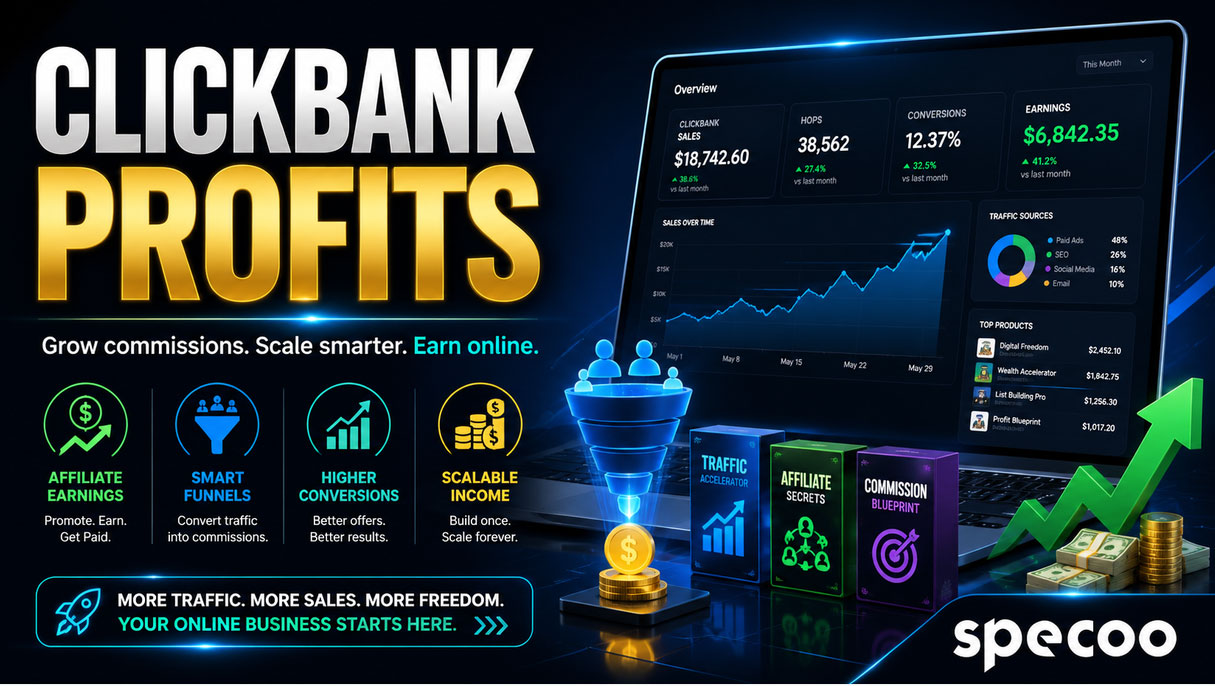
This piece breaks down how ClickBank profits are actually built — the mechanics, the traffic, the mistakes that quietly drain campaigns, and the tools that make the process manageable. Along the way we’ll point to a system that many affiliates are currently testing, ClickBank Profits, which packages several of these steps into a single funnel.
What ClickBank Actually Is
ClickBank is an affiliate marketplace and e-commerce platform that connects the people who create digital products — courses, ebooks, software, coaching programs, and a growing number of physical goods like supplements — with the marketers who sell those products to an audience. A vendor lists an offer, ClickBank handles the checkout, tax collection, and payment processing, and an affiliate generates a unique tracking link (called a “hoplink”) to promote that offer. Every sale made through that link pays the affiliate a commission, often a large one.
The scale here is worth noting. ClickBank generates close to a quarter-billion dollars in yearly sales revenue, and more than 30,000 transactions are processed on the platform every day across upwards of 190 countries. That volume is why ClickBank shows up so often in “how to make money online” conversations — there’s simply a lot of buyer traffic already flowing through the system, and the company is regularly ranked among the top 100 businesses in the world for online commerce.
The Two Ways People Earn on ClickBank
ClickBank offers two main earning paths — affiliate and seller — and most beginners do better focusing on one before trying to expand into the other.
Affiliates don’t create anything. They pick an existing offer, generate a tracking link, send traffic to it through free or paid channels, and collect a commission on each sale. This is the lower-barrier path and where nearly everyone starts.
Sellers build the product itself, set the commission structure, and recruit affiliates to promote it for them. This path has a much higher ceiling, but it also requires product development, copywriting, and — critically — attracting affiliates willing to promote you, which usually means proving strong conversion numbers first.
Most of this article focuses on the affiliate side, since that’s where the majority of “ClickBank profits” searches originate and where a system like ClickBank Profits is designed to shorten the learning curve.
How Commissions Actually Work
ClickBank’s commission rates are unusually generous compared to physical-product affiliate networks. Because the marketplace focuses heavily on digital products — ebooks, courses, software, and membership programs — commission rates often run as high as 75%, since there’s no manufacturing or shipping cost eating into the vendor’s margin.
Two metrics matter more than the headline commission percentage, though:
Gravity Score
Gravity is ClickBank’s rough measure of how many unique affiliates have generated a sale for a given product in a recent window. A high gravity score tells you the offer is actively converting for other marketers right now — not that it converted well two years ago. It’s a useful filter, not a guarantee.
EPC (Earnings Per Click)
EPC tells an affiliate how much they’re earning “per click,” which matters because it lets you compare that figure directly against what you’re spending per click on a traffic source like Facebook or Google Ads. If your EPC is $1.20 and your cost per click is $0.80, you have a profitable campaign. If it’s reversed, you’re funding someone else’s business.
Building a ClickBank Profits Strategy From Scratch
There’s no single “correct” way to build income on ClickBank, but the affiliates who move from occasional sales to consistent income tend to follow a similar sequence.
Step 1: Choose a Niche You Can Sustain
The biggest predictor of long-term ClickBank profits isn’t the commission rate — it’s whether the marketer can keep producing content and traffic in that niche for months without losing interest. Health, wealth, and relationships remain the three dominant categories on the platform because they’re evergreen, but “evergreen” doesn’t mean “easy.” Pick a niche where you can plausibly write, film, or advertise consistently for six months.
Step 2: Vet the Offer Before You Promote It
Before sending a single click to any hoplink, check the sales page, the refund rate, and the vendor’s reputation. Refund rates above roughly 5% are usually a sign to move on — high refunds don’t just cost you future commissions through chargebacks, they also damage the trust your audience places in your recommendations. A product with a lower gravity score but a clean refund history is often a better long-term bet than a trending offer with a shaky reputation.
Step 3: Build a Bridge, Not Just a Bare Link
Sending cold traffic directly to a vendor’s sales page rarely converts well, and most paid ad platforms restrict bare affiliate links outright. The standard workaround is a “bridge page” — a short review, a quiz, a lead magnet, or a video that warms the visitor up before they click through to the offer. This is also where email capture happens, which matters enormously for long-term profits, since most buyers don’t purchase on their first visit.
Step 4: Choose a Traffic Channel and Commit
Traffic is where most new affiliates stall out, largely because they spread thin attention across five channels instead of mastering one. The realistic options are:
- Organic content (YouTube, blogging, TikTok, Pinterest) — slower to build, but free and compounding over time
- Paid advertising (Facebook, Google, native ad networks) — faster feedback, but requires a budget and a stomach for losses while you learn
- Email marketing — not a traffic source on its own, but the highest-leverage asset once you have a list, since it lets you promote new offers to the same audience repeatedly
Step 5: Track, Test, and Adjust
ClickBank’s own dashboard shows clicks, conversion rate, and earnings in real time, but affiliates who scale usually layer in a separate tracking tool so they can see which specific ad, headline, or piece of content is actually producing sales. Without this, it’s nearly impossible to know what to scale and what to kill.
Where a Done-For-You System Fits In
Every one of the five steps above takes real time to learn from scratch — vetting offers, writing bridge pages, setting up tracking, building an email sequence. That’s the gap that pre-built systems like ClickBank Profits are designed to close. Rather than building a funnel, bridge page, and email sequence from zero, an affiliate plugs into an already-assembled structure and focuses their energy on the one variable they still have to supply themselves: traffic.
This doesn’t remove the work — no legitimate system does — but it does compress the setup phase, which is often where new affiliates lose momentum before they ever see a first sale. If you’re evaluating an offer like this, apply the same vetting standard from Step 2 above: check the refund policy, read the terms carefully, and confirm the claims match what you’re actually being asked to do.
Common Mistakes That Quietly Kill ClickBank Profits
A few patterns show up again and again in affiliates who struggle:
Promoting too many offers at once. Splitting attention across ten products in ten niches means never generating enough data on any single one to know if it’s working.
Ignoring the refund window. ClickBank commissions can be clawed back if a buyer refunds within the vendor’s return period, which is often 30 to 60 days. Affiliates who don’t account for this in their cash-flow planning are sometimes surprised when a “profitable” month gets revised downward.
Treating the first campaign as the final campaign. Almost no first funnel is profitable. The marketers who succeed treat their first attempt as a data-gathering exercise, not a verdict on the whole business model.
Skipping the email list. A hoplink sends a visitor to one offer, once. An email list lets you promote to that same visitor for years. Affiliates who never build a list are leaving most of their long-term profit on the table.
Chasing gravity instead of fit. The highest-gravity product in a category isn’t automatically the right one for your specific audience or content style. A slightly lower-gravity offer that matches your traffic source can outperform the market leader.
Organic vs Paid Traffic: Which Builds Profits Faster
This is the question that divides ClickBank affiliates into two camps, and the honest answer is: it depends on your starting resources.
Paid traffic gives you data within days. You can test three headlines, two landing pages, and a handful of ad creatives in a single week and know almost immediately whether an offer converts. The tradeoff is that you’re paying for that speed, and losses during the testing phase are real money, not just wasted time.
Organic traffic — a blog, a YouTube channel, a niche Pinterest account — takes months to build meaningful volume, but once it’s built, it keeps producing clicks without ongoing ad spend. A well-ranked blog post from a year ago can still be sending buyers to a hoplink today.
Most sustainable ClickBank businesses eventually use both: paid traffic to validate an offer quickly, and organic content to scale it cheaply once it’s proven.
Scaling: From First Commission to Consistent Income
The gap between an affiliate’s first sale and their first consistent month is almost always a systems problem, not a talent problem. Once a campaign is proven profitable at a small scale, the path forward looks like this:
- Increase budget gradually on the traffic source that’s already working, rather than immediately branching into a new channel
- Build a follow-up sequence so buyers and non-buyers alike keep receiving related offers over time
- Diversify within the niche, not across niches — promoting two or three related ClickBank offers to the same audience reduces reliance on any single vendor
- Reinvest a fixed percentage of profits into testing new creative or content rather than spending everything as it comes in
This is also the stage where a pre-built framework like ClickBank Profits tends to be most useful — not for finding the first sale, but for giving an affiliate a repeatable structure to plug new traffic into once they know a channel works.
Tools and Resources Worth Bookmarking
A short, reliable resource list saves far more time than a long one full of outdated advice:
- ClickBank — the marketplace itself, where you browse offers, pull hoplinks, and track your account dashboard
- ClickBank’s official blog — updated regularly with current top-performing offers, EPC data, and platform policy changes
- ClickBank Accounts — where affiliates manage payment settings, tax forms, and account verification
Outside of ClickBank’s own properties, most affiliates also keep a landing-page builder, an email autoresponder, and a link-tracking tool in their stack. The specific brands matter less than picking one of each and learning it thoroughly rather than switching tools every month.
Frequently Asked Questions
Is ClickBank still worth using? Yes, for affiliates willing to treat it like a real business rather than a lottery ticket. The platform’s scale and commission rates remain competitive with newer networks, and its two-decade track record of paying affiliates on time is a genuine advantage over many younger platforms.
How much can a beginner realistically earn? There’s no honest fixed number — outcomes depend on niche, traffic source, offer quality, and consistency. It’s normal not to see profit in the first month; the affiliates who eventually do well are the ones who keep refining their metrics and offer selection rather than quitting early.
Do I need a website to start? No. Many affiliates start with YouTube, social content, or paid ads pointed at a simple bridge page rather than a full website. A website helps long-term SEO and credibility, but it isn’t a requirement to get a first sale.
What’s the biggest difference between ClickBank and Amazon Associates? Commission size, mostly. Amazon’s rates typically sit in the low single digits; ClickBank’s digital-product commissions can run as high as 75%, which means far fewer sales are needed to reach the same income.
Final Thoughts
ClickBank profits are real, but they’re built the same way profits are built in most small businesses — by choosing a defensible niche, vetting the products carefully, sending consistent traffic, and improving the system a little each month rather than chasing a single breakthrough campaign. The affiliates who burn out are usually the ones expecting the first funnel to work; the ones who stick around long enough to see real income are the ones who treated their first few campaigns as tuition.
For marketers who’d rather start from an assembled framework than build every piece themselves, ClickBank Profits is one option worth reviewing against the vetting checklist above — refund policy, realistic claims, and fit with the traffic source you actually plan to use.
Related Posts