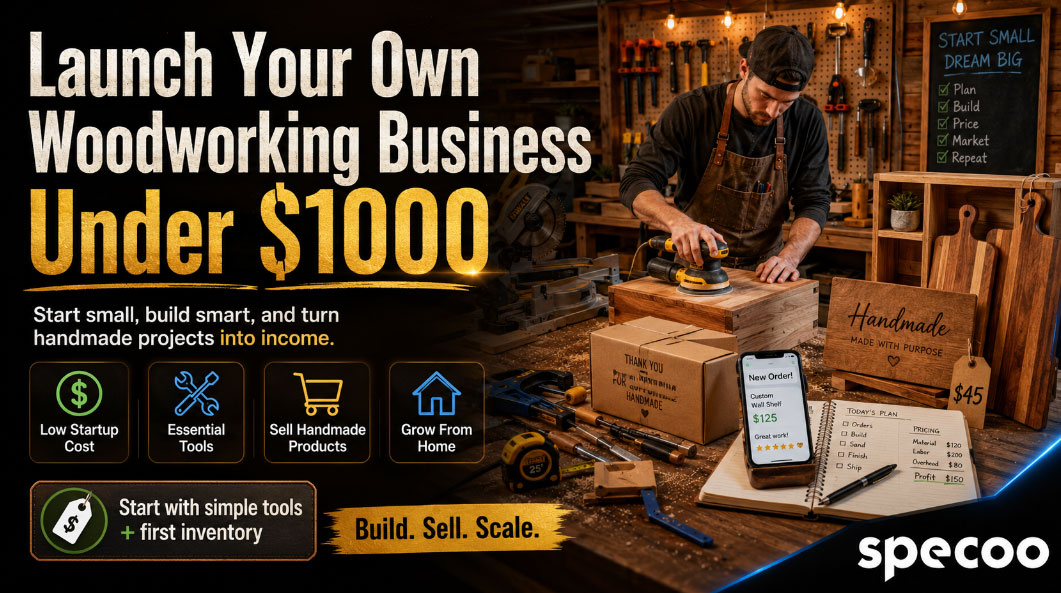
How to Launch Your Own Woodworking Business Under $1,000
Sawdust doesn’t care how much money you have. Neither does a customer who just wants a solid cutting board, a live-edge shelf, or a set of coasters that don’t look like they came from a big-box clearance bin. That’s the quiet secret behind the current boom in small-batch woodworking businesses: the tools matter less than people think, and the money matters even less than the tools.
Every year, thousands of people talk themselves out of starting a woodworking business because they assume it requires a fully outfitted garage, a table saw with a laser guide, and a business loan. It doesn’t. What it actually requires is a clear plan, a narrow focus, and the discipline to spend your first dollars on things that make you money instead of things that just look impressive. This guide walks through exactly how to do that — start to first sale — for less than $1,000.
Why Woodworking Is One of the Most Forgiving Businesses You Can Start
Compare a woodworking business to almost any other small business, and the math tilts in your favor immediately. You don’t need a storefront. You don’t need employees. You don’t need inventory sitting on a shelf for months before it sells, because most small woodworking businesses build to order or in short batches. And you don’t need a factory’s worth of equipment — a circular saw, a drill, a sander, and a few clamps can produce dozens of sellable products.
Demand has held up, too. Buyers on marketplaces like Etsy consistently search for “handmade wood,” “custom sign,” and “personalized cutting board” because mass-produced alternatives feel generic. A wobbly, hand-planed edge is a feature, not a flaw, to that customer. That’s the opening a bootstrapped woodworker can walk through without competing on price against overseas factories.
None of this means it’s effortless. It means the barrier to entry is low enough that your biggest obstacle is decision paralysis, not capital.
The Under-$1,000 Math: Where Your Money Actually Goes
Before diving into steps, it helps to see the whole budget laid out. Most people who blow past $1,000 do it by buying tools they don’t need yet, not by overspending on the stuff that actually generates revenue.
| Category | Suggested Budget | What It Covers |
|---|---|---|
| Core hand and power tools | $350–$450 | Circular saw, drill/driver, orbital sander, clamps, measuring/marking tools, safety gear |
| Materials for first batch | $100–$150 | Lumber, plywood, hardware, finish, glue for your first 10–20 products |
| Legal & admin setup | $50–$150 | Business name registration, EIN (free), local permit if required |
| Online selling setup | $0–$100 | Etsy listing fees, a basic website, or a free Facebook Shop |
| Photography & packaging | $50–$100 | A secondhand ring light, backdrop paper, tape, kraft boxes |
| Marketing buffer | $50–$100 | Boosted local posts, business cards, a few paid Etsy ads |
| Total | $600–$950 | Leaves a cushion under the $1,000 ceiling |
Notice what’s missing: a dust collection system, a CNC router, a planer, a jointer. Those are second-year purchases, funded by first-year profits — not startup costs.
Step 1: Pick a Niche Before You Pick Up a Saw
The single biggest mistake new woodworkers make is trying to build “custom furniture” as their opening move. Furniture is heavy, slow to produce, expensive to ship, and hard to price competitively when you’re new. Instead, successful low-capital shops usually start with small, fast, repeatable products:
- Cutting boards and charcuterie boards
- Floating shelves and wall organizers
- Cornhole boards and yard games
- Personalized signs and house-number plaques
- Small pet furniture (feeding stations, steps, crates)
- Coasters, trivets, and desk organizers
- Jewelry boxes and small keepsake boxes
Pick one category to start. A tight niche does two things: it lets you buy materials in bulk for a single project type (cheaper per unit), and it gives search engines and shoppers a clear reason to find you. “Custom cutting boards” ranks and sells; “handmade wood things” does neither.
Step 2: Build a Bare-Bones Shop Without Breaking the Bank
You don’t need a dedicated workshop. A garage, a shed, a covered patio, or even a corner of a basement with good ventilation will work for your first year. Focus spending on a short list of genuinely essential tools:
- A corded circular saw (cheaper and more durable than a starter table saw)
- A drill/driver combo
- An orbital sander
- A set of bar clamps (at least four)
- A speed square, tape measure, and pencil
- Safety glasses, hearing protection, and a dust mask
Buy used where you can. Estate sales, local classifieds, and secondhand tool listings routinely turn up quality tools at 40–60% off retail. When you do need something new, a physical woodworking specialty retailer is worth a visit for advice as much as inventory — Woodcraft, headquartered at 1177 Rosemar Road, Parkersburg, WV 26105, runs dozens of stores nationwide and its staff will often talk a beginner through exactly what’s necessary versus what’s optional. Rockler Woodworking and Hardware is a similar national resource if there’s a branch near you.
Step 3: Make It Legal Without Paying a Lawyer’s Retainer
This step gets skipped constantly, and it’s the one that causes the most regret later. The good news: for a one-person woodworking operation, the legal setup is genuinely simple and mostly free.
- Choose a structure. Most beginners start as a sole proprietorship, which requires no separate filing — you’re automatically one the moment you sell something. An LLC offers liability protection and typically costs $50–$150 to file with your state, depending where you live.
- Get an EIN. The IRS issues Employer Identification Numbers for free through its online EIN application. You’ll want one to open a business bank account and keep your finances separate from day one.
- Check local permits. Many cities require a home occupation permit if you’re running a business from your house, especially one involving power tools. A quick call to your city clerk’s office clears this up fast.
- Get free guidance. The U.S. Small Business Administration (headquartered at 409 3rd Street SW, Washington, DC 20416) publishes free startup checklists by state, and SCORE (1175 Herndon Parkway, Suite 900, Herndon, VA 20170) pairs new business owners with volunteer mentors — many of them retired manufacturing or retail executives — at no cost.
None of this needs to happen before your first sale, but it should happen before your tenth.
Step 4: Source Materials Like a Business, Not a Hobbyist
Lumber is where margins are won or lost. Hobbyists buy pre-surfaced boards at retail price from the aisle of a home improvement store. Business owners find cheaper, better wood elsewhere:
- Rough-cut lumber from local sawmills is often 30–50% cheaper than dimensional lumber at a big-box store, and it lets you mill boards to your exact spec.
- Cutoff and clearance racks at lumber yards sell shorter, “imperfect” boards at steep discounts — perfect for cutting boards, coasters, and small signs.
- Pallet wood, once de-nailed and cleaned, is functionally free and works well for rustic-style products, which happen to be in high demand right now.
- Local classifieds and estate sales occasionally turn up entire stashes of aged, kiln-dried hardwood from a retiring woodworker at a fraction of lumberyard prices.
Buy only what your first batch needs. Overbuying materials before you have sales data on what actually sells is the second most common way new shops burn through their $1,000.
Step 5: Price for Profit, Not Just to Move Product
Underpricing is the quiet business killer. A simple formula keeps you from doing it:
(Materials cost + your hourly rate × hours worked) × 1.5 to 2 = retail price
The multiplier covers overhead, platform fees, waste, and the fact that your time is worth something even when you love the work. If a cutting board costs $6 in materials and takes 45 minutes, and you value your time at $20/hour, that’s $6 + $15 = $21 in raw cost. At a 1.75x multiplier, it should retail for roughly $37, not $22. New sellers who price at cost-plus-a-little rarely last a year; the ones who price for margin can reinvest and grow.
Step 6: Choose Where to Sell
This decision shapes your fees, your audience, and how much marketing you’ll need to do. Here’s how the major channels stack up for a brand-new, low-budget shop:
| Platform | Startup Cost | Typical Fees | Best For | Downside |
|---|---|---|---|---|
| Etsy | Near $0 | $0.20 per listing + 6.5% transaction fee + ~3% + $0.25 payment processing | Small, giftable items with built-in buyer intent | Fees compound quickly at low price points |
| Amazon Handmade | $0 (no monthly fee) | 15% referral fee per sale | Higher-ticket items ($40+) with broad reach | Application/approval process; less “craft” branding |
| Facebook Marketplace | $0 | None | Local sales, bulky items, no shipping hassle | Limited to your geographic area |
| Local craft fairs & farmers markets | $25–$150 per event (booth fee) | None on sales | Direct feedback, cash sales, community reputation | Time-intensive; weather-dependent |
| Your own website (e.g., Shopify) | ~$29–$39/month | ~2.9% + $0.30 payment processing | Full brand control, no marketplace competition | You supply all your own traffic |
Most new woodworking businesses do best starting with one online marketplace and one in-person channel — say, Etsy plus a monthly local market — rather than spreading thin across five platforms before there’s proof of demand.
Step 7: Market Without a Marketing Budget
You don’t need paid ads to get your first twenty sales. You need visibility in the places your buyer already looks.
- Photograph obsessively. Natural window light and a plain backdrop outperform a expensive camera. Buyers judge handmade wood products almost entirely on photos.
- Post the process, not just the product. Short videos of sanding, finishing, or assembling consistently outperform static photos on Instagram and TikTok because they signal craftsmanship.
- Join local buy-sell-trade and maker groups on Facebook. These groups convert surprisingly well for anything local and pickup-friendly.
- Ask every buyer for a review. A handful of genuine reviews on a new Etsy shop does more for conversion than any ad spend at this stage.
- Show up at one recurring local market. Repetition builds a customer base that follows you online afterward.
Step 8: Learn From People Who’ve Already Done It
You don’t have to figure out pricing psychology, niche selection, or online marketing from scratch. A few resources are worth knowing about:
- The American Association of Woodturners (220 Landmark Center, 75 5th Street West, Saint Paul, MN 55102) runs local chapters across the country where hobbyists and small-business owners trade advice, and many chapters welcome newcomers at open meetings.
- Fine Woodworking publishes technique-focused articles and project plans that are useful once you’re refining your craft, not just your business.
- The r/woodworking community on Reddit is blunt but genuinely useful for troubleshooting technique and getting honest feedback on pricing.
- Paid, structured guides exist too, for people who’d rather follow a step-by-step system than assemble their own. WoodProfits, created by longtime home-based woodworker Jim Morgan, is one such option — a downloadable guide covering niche selection, pricing, and marketing for a home woodworking business, sold with a bundle of project plans and a money-back guarantee. As with any paid business course, treat the specific income figures on its sales page as marketing claims rather than guarantees, and weigh it against the free resources above before deciding whether the structure is worth paying for.
Common Mistakes That Sink New Woodworking Businesses
Most failures in this space trace back to a handful of repeatable errors:
- Buying tools for the business you wish you had, instead of the one you’re actually running this month.
- Skipping the niche decision and trying to be a general “custom woodworking” shop with no clear search term or buyer in mind.
- Underpricing to compete with mass-produced goods you were never actually competing against.
- Ignoring the legal basics until a landlord, a client, or a tax season forces the issue.
- Overbuilding inventory before sales data shows what customers actually want.
Your First 30 Days, Step by Step
- Week 1: Choose your niche, sketch your first three product designs, and buy your core tool kit secondhand where possible.
- Week 2: Register your business name, get your free EIN, and open a separate business bank account.
- Week 3: Build your first batch of 8–12 products, photograph them, and list them on one marketplace.
- Week 4: Apply for a table at a local market or craft fair, post your process on social media, and make your first sales push.
By day 30, you won’t have a polished company. You’ll have something better: proof that people will pay you for what you make, and a clear read on what to spend your next $500 on.
Frequently Asked Questions
Can you really start a woodworking business for under $1,000? Yes, if you focus on small, fast-to-produce items rather than furniture, buy used tools for your core kit, and treat expensive equipment as a second-year purchase funded by early profits rather than a startup requirement.
What woodworking products sell best for beginners? Small, giftable items with broad appeal tend to sell fastest for new shops: cutting boards, personalized signs, coasters, floating shelves, and yard games like cornhole boards. They’re cheap to produce, easy to ship or hand-deliver, and don’t require advanced joinery skills.
Do I need an LLC to sell handmade wood products? No. Most new woodworking businesses start as sole proprietorships, which require no separate filing. An LLC adds liability protection and is worth considering once you’re selling regularly or working with larger commissioned pieces, but it isn’t a legal requirement to make your first sales.
Is Etsy or Amazon Handmade better for a new woodworking shop? Etsy tends to work better for smaller, lower-priced, giftable items because of its built-in gift-shopping audience, while Amazon Handmade’s flat 15% referral fee (with no listing fee) often works out better for higher-ticket items over roughly $40. Many sellers eventually list on both once they know which products perform where.
None of this replaces professional legal, tax, or financial advice specific to your state and situation — the SBA and SCORE resources above are free starting points for those conversations.
Related Posts