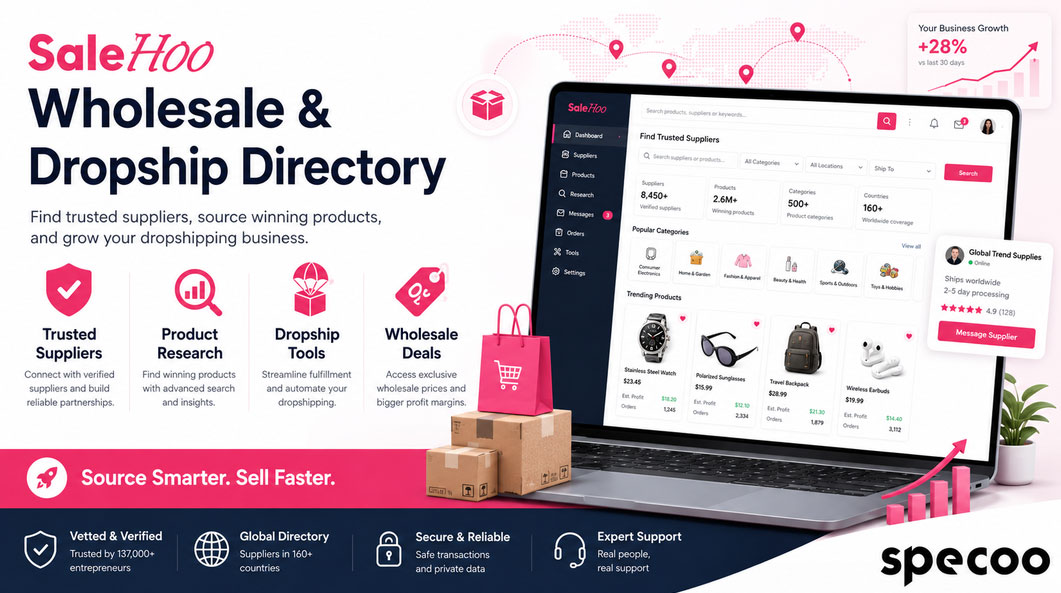
SaleHoo Wholesale & Dropship Directory: An Honest Look at the Platform Behind 137,000 Online Sellers
Every year, a fresh wave of would-be entrepreneurs types some version of “how do I find a supplier I can actually trust” into a search bar. It’s one of the oldest problems in online retail, and it hasn’t gotten much easier just because the internet got bigger. If anything, more suppliers means more noise — more fake wholesalers, more minimum-order traps, more “too good to be true” listings that turn out to be exactly that.
SaleHoo built its entire business around solving that one problem. For two decades, it has positioned itself as a curated middle ground between the chaos of open marketplaces and the six-figure cost of building a private sourcing network from scratch. This piece walks through what SaleHoo actually is, who runs it, what you get for your money, and how it stacks up against the other names you’ll inevitably hear while researching wholesale and dropshipping suppliers.
Quick Facts Before We Go Deeper
- Company: SaleHoo Group Limited
- Founded: 2005
- Founders: Simon Slade and Mark Ling
- Headquarters address: 1020 Ferry Road, Ferrymead, Christchurch, Canterbury 8023, New Zealand
- Parent company: Doubledot Media Limited
- Core product: A vetted directory of wholesale, dropship, and liquidation suppliers, paired with market research and store-building tools
- Starting price: From $9/month, with lifetime-access options available
- Product link: SaleHoo Wholesale & Dropship Directory
What Exactly Is SaleHoo?
At its core, SaleHoo is a wholesale supplier directory that connects online sellers with more than 2.5 million branded products sourced from over 8,000 manufacturers, wholesalers, dropshipping suppliers, and liquidation companies worldwide. It’s worth being precise about what that means, because a lot of first-time sellers get this wrong: SaleHoo doesn’t manufacture or ship anything itself. It’s a structured directory where retailers and suppliers find and contact each other — think of it less as a warehouse and more as a very carefully curated phone book, one where every listing has already been checked for legitimacy before it ever appears.
That vetting step is the whole value proposition. Anyone can search “wholesale suppliers” and land on a thousand websites. Very few of those websites have had a human being verify that the company behind them actually ships real products, honors minimum-order terms, and won’t disappear with a wire transfer. SaleHoo’s pitch is that it’s already done that legwork, so sellers spend their time picking products instead of chasing down company registration numbers.
Where SaleHoo Comes From: A Quick History
The company’s origin story is fairly typical of early-2000s e-commerce founders, which is part of what gives it credibility. SaleHoo Group Limited was founded in 2005 by Simon Slade and Mark Ling, and the idea reportedly grew out of Slade’s own frustration as a seller on Trade Me, New Zealand’s local auction site — he kept getting asked where he sourced his products, and realized there was no reliable answer to give people.
Company address: SaleHoo’s operations are based at 1020 Ferry Road, Ferrymead, Christchurch, Canterbury, New Zealand, a city on New Zealand’s South Island that has quietly become something of a hub for e-commerce and SaaS companies. The business operates as part of its parent company, Doubledot Media Limited, which was named the 23rd fastest-growing company in New Zealand on the Deloitte/Unlimited Fast 50 index — a reasonable signal that this isn’t a fly-by-night operation cobbled together last quarter.
What’s notable is the platform’s staying power. Most directories from that era have folded, rebranded three times, or quietly turned into content farms. SaleHoo, by contrast, has kept iterating on the same core idea for twenty years: verify suppliers, organize them by niche and minimum order, and layer in the research tools sellers actually need to decide what to sell in the first place.
Inside the Directory: What You Actually Get
A SaleHoo membership isn’t a single tool — it’s a bundle of them, and understanding each piece matters before you decide whether it’s worth paying for.
The Supplier Directory
This is the headline feature. Members get searchable access to a global supplier directory covering more than 8,000 manufacturers, wholesalers, dropshipping suppliers, and liquidation companies. You can filter by product category, supplier type, minimum order quantity, and shipping location — a detail that matters more than it sounds like it should, because a supplier with a 500-unit minimum is useless to someone testing a product for the first time.
Market Research Lab
Picking a product is often harder than finding a supplier for it. SaleHoo’s research tool pulls sales data and competition metrics to help sellers gauge demand before committing money to inventory or ad spend — essentially trying to answer “will anyone actually buy this” before you find out the expensive way.
SaleHoo Dropship
For sellers who want automation rather than manual sourcing, SaleHoo also offers a dedicated dropship product that integrates with major platforms including WooCommerce, Shopify, BigCommerce, Magento, eBay, and Amazon, syncing inventory and automating order routing so you’re not manually forwarding every order to a supplier.
Community and Education
This is the part reviewers tend to undersell. SaleHoo maintains a 137,000-member community forum where sellers trade notes on suppliers, niches, and what’s actually working right now — which is often more current and more honest than anything in a paid course. Alongside that sits SaleHoo Educate, a set of structured lessons covering everything from Shopify store setup to Amazon FBA basics, aimed squarely at people who’ve never run an online store before.
A Timely Detail: US-Based Suppliers
One feature that’s become more relevant lately: SaleHoo’s directory includes US-based wholesale and dropshipping suppliers, whose domestic shipping times of roughly 3–7 days compare favorably to the 15–45 days typical of overseas sourcing, and who sit outside the tariff changes that followed the 2025 de minimis policy shift. For sellers who got burned by unpredictable customs fees or shipping delays over the past year, that’s not a minor footnote — it’s arguably the most practical reason to look at a domestic-leaning directory right now instead of defaulting to overseas marketplaces.
How Much Does SaleHoo Actually Cost?
Pricing is where a lot of directories lose people’s trust, either through vague “contact us” pages or subscriptions that balloon after the first month. SaleHoo is fairly transparent here. Plans start from $9 a month, with a one-time lifetime access option also available, and the company backs every plan with a 60-day money-back guarantee — which is a genuinely long window compared to the 14- or 30-day guarantees most competitors offer.
Breaking it down further, the Starter plan runs $9 per month billed annually, while the Pro plan is $49 per month and adds three sub-users, three connected Shopify stores, unlimited supplier contacts, and higher product import limits. For someone just testing whether dropshipping or wholesale reselling is a viable path for them, Starter is more than enough. Pro starts to make sense once you’re running multiple stores or need to bring on a virtual assistant.
A word on money-back guarantees generally: they’re a real, useful risk-reducer, but they’re not a substitute for reading the terms yourself before you subscribe. Prices, plan names, and what’s bundled into each tier can and do change, so it’s worth checking the current pricing page directly before committing rather than relying on any single article — including this one.
Who SaleHoo Is Actually Built For
No sourcing tool is right for every seller, and pretending otherwise does readers a disservice.
SaleHoo tends to work well for:
- First-time online sellers who don’t yet have supplier relationships and don’t want to spend months building them from zero
- eBay and Amazon sellers who need pre-vetted suppliers rather than cold-emailing manufacturers overseas
- Shopify store owners who want dropship automation without stitching together five separate apps
- Anyone burned before by a supplier scam and who now wants a layer of verification between them and a new vendor
It’s less of a fit for:
- Sellers who already have established, direct manufacturer relationships and don’t need a middleman directory
- Businesses sourcing highly specialized industrial or custom-manufactured goods that wouldn’t appear in a general consumer-products directory
- Anyone expecting a directory subscription alone to guarantee sales — no supplier list, however good, replaces product-market fit, decent marketing, and reasonable margins
That last point matters enough to repeat: a supplier directory reduces the risk of sourcing, it doesn’t remove the work of running a business. Some marketing around dropshipping in general leans on eye-catching income figures. Treat those as anecdotes, not projections — actual outcomes depend heavily on niche selection, pricing discipline, ad spend, and plain persistence, and they vary enormously from seller to seller.
SaleHoo vs. The Other Names You’ll Keep Hearing
Anyone researching this space runs into the same handful of competitors over and over. Here’s how they generally compare, in plain terms:
Wholesale Central — A free-to-browse directory of wholesale distributors. No membership fee, but also no vetting process, no research tools, and no community — you’re on your own to verify each listing.
Worldwide Brands — SaleHoo’s closest direct competitor, also offering a certified, vetted supplier directory with a one-time lifetime fee. Generally priced higher, with a narrower focus on the directory itself rather than bundled research or store-building tools.
Alibaba — A massive B2B marketplace, mostly connecting buyers directly to Chinese manufacturers. Enormous selection and often lower unit costs, but no vetting layer of the kind SaleHoo provides — due diligence on any individual factory is entirely on you.
DHgate — Similar territory to Alibaba but oriented more toward smaller order quantities, which suits dropshippers testing products before committing to bulk buys.
Doba — A subscription-based dropship aggregator with automation features comparable to SaleHoo Dropship, though historically priced noticeably higher at the top tier.
AliExpress — The default for a huge share of dropshippers, mainly because there’s no membership cost at all. The tradeoff is longer international shipping times and effectively no supplier screening — you’re reading reviews and hoping for the best.
The honest summary: if your priority is the absolute lowest unit price and you’re comfortable doing your own supplier vetting, Alibaba or AliExpress will usually beat SaleHoo on cost. If your priority is reducing the odds of getting scammed or ghosted by a supplier, and you’d rather pay a modest membership fee for that peace of mind plus research tools and a community, SaleHoo (or Worldwide Brands) is the more sensible lane.
Getting Started: What the Process Actually Looks Like
For readers who decide to give it a try, the setup process is fairly linear:
- Choose a plan. Starter is the sensible entry point for testing the waters; Pro suits sellers already running multiple stores.
- Run a product search in the Market Research Lab before browsing suppliers — it’s easy to fall in love with a product idea that has no real demand behind it.
- Filter the supplier directory by category, minimum order quantity, and shipping origin. Domestic US suppliers are worth prioritizing right now given current shipping and tariff dynamics.
- Contact two or three suppliers directly, even for products that look promising on paper. Response time and communication quality tell you a lot before you ever place an order.
- Order a sample before committing to a bulk purchase or setting up automated dropshipping through SaleHoo Dropship.
- Connect your store (Shopify, WooCommerce, or another supported platform) if you’re using the automation tools, and set your markup and pricing rules.
- Use the 60-day guarantee window deliberately. Treat the first two months as a genuine evaluation period rather than an afterthought — actually test the tools before deciding whether to keep the subscription.
Frequently Asked Questions
Is SaleHoo legitimate, or is it a scam? SaleHoo is a real, incorporated company operating out of Christchurch, New Zealand, founded in 2005 and still active two decades later. It’s not a get-rich-quick scheme — it’s a paid directory service, and the honest way to evaluate it is the same way you’d evaluate any subscription tool: by what it actually delivers relative to its cost.
Does SaleHoo sell products directly? No. SaleHoo connects sellers to third-party suppliers; it doesn’t manufacture, warehouse, or ship inventory itself. Your relationship for order fulfillment is with the supplier you choose, not with SaleHoo.
Can I use SaleHoo with Amazon or eBay, or only Shopify? The core supplier directory works with any sales channel — Amazon, eBay, Etsy, or your own website. The dedicated SaleHoo Dropship automation tool is more tightly built around Shopify integration specifically.
What’s the actual difference between the Starter and Pro plans? Starter covers one store connection and a capped number of monthly product imports — enough to validate an idea. Pro adds multiple sub-users, additional connected stores, and unlimited supplier contacts, which matters more once you’re operating at scale or delegating tasks to a team.
Is there a free trial? SaleHoo offers a money-back guarantee window rather than a traditional free trial, giving you 60 days to use the platform and request a refund if it’s not a fit.
How is SaleHoo different from just using AliExpress for free? AliExpress costs nothing to browse, but nothing on it has been independently vetted, and shipping times run considerably longer. SaleHoo charges a membership fee in exchange for pre-screened suppliers, research tools, and a large seller community — it’s a tradeoff of cost versus reduced risk and faster fulfillment options.
Will SaleHoo guarantee I make money? No directory can guarantee that, and any that claims otherwise should be treated with skepticism. SaleHoo reduces sourcing risk and research time; the rest of the business — pricing, marketing, customer service, and execution — is still entirely on the seller.
Final Verdict
SaleHoo isn’t flashy, and it doesn’t need to be. Two decades in an industry known for churn is its own kind of proof — directories that don’t deliver real value tend to disappear long before they hit a 137,000-member community. What it offers is fairly narrow but genuinely useful: a shortcut past the most tedious and risk-laden part of starting an online retail business, backed by research tools and a community that keeps the information current.
It won’t replace good product judgment, and it won’t do your marketing for you. But for someone standing at the starting line of dropshipping or wholesale reselling, unsure which supplier leads are real and which are traps, it’s a reasonable place to spend the first few weeks of research instead of the first few months.
If you want to look at current plans, supplier categories, and the guarantee terms directly, you can view the full directory here: SaleHoo Wholesale & Dropship Directory.
Related Posts