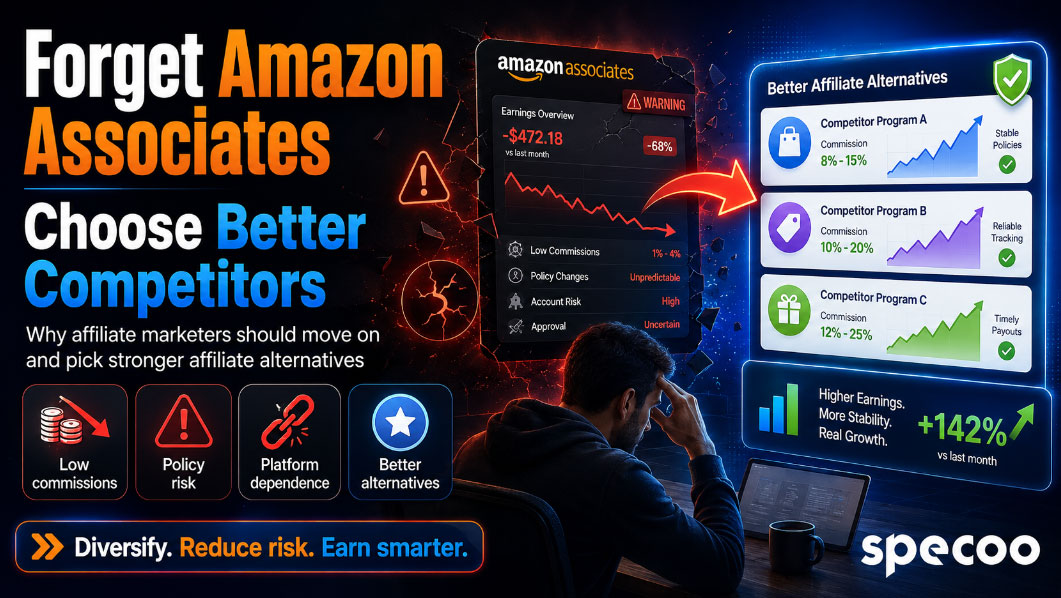
Why Smart Affiliate Marketers Are Quietly Walking Away From Amazon Associates
- specoo
- August 29, 2026
- Affiliate Marketing
For fifteen years, “start an affiliate site” and “join Amazon Associates” were basically the same sentence. It was the default. The training-wheels program. The one every course, every YouTube tutorial, and every “how to make money blogging” listicle pointed to first. And for a long stretch, that made sense — Amazon had the biggest catalog on earth, near-universal brand trust, and a checkout process nobody had to be talked into.
But the affiliates who are actually growing their income in 2026 are telling a different story. Quietly, without much fanfare, a lot of experienced publishers have stopped treating Amazon Associates as their main event. Some have cut it down to a supporting role. Others have dropped it entirely. The reasons aren’t emotional — they’re arithmetic. Low commission ceilings, a cookie window shorter than most people’s attention span, and a rulebook that gets rewritten without much warning have pushed the math in a different direction.
This isn’t an argument to burn your Amazon tag and walk into the woods. It’s an argument for something more useful: understanding exactly why the program that made affiliate marketing mainstream is no longer the best place to put your best traffic, and knowing which competitors are genuinely worth your time instead.
The Amazon Associates Illusion
Amazon Associates looks generous from a distance because the catalog is infinite. Up close, the economics tell a tighter story.
Standard commission rates run roughly 1% to 10% depending on category, with a small number of exceptions — Amazon Games and select digital categories have historically sat near the top of the rate card, while mainstream categories like consumer electronics, computers, and video games often land at the bottom, sometimes as low as 1%. That’s a strange incentive structure for an affiliate: you can pour months of research into a “best laptops” guide and earn less per sale than someone reviewing board games.
Then there’s the cookie. Amazon’s tracking window is 24 hours. Click today, buy tomorrow afternoon, and the sale doesn’t belong to you anymore. There is a partial safety net — if a shopper adds something to their cart within that 24-hour window, eligibility can stretch to 90 days or until checkout, whichever comes first — but that’s a narrower net than it sounds, because it only protects items already sitting in the cart, not a shopper who closes the tab and comes back next week to browse again.
Amazon also tightened its rules again in the spring of 2026. The updated Associates Operating Agreement introduced a 180-day qualification requirement — meaning a click only earns commission if the customer actually pays for and receives (or streams or downloads) the product within that window — alongside reduced payouts on some of the in-cart “halo” purchases that used to pad affiliate earnings, and a stricter standard for what counts as original content on an approving site. None of these changes were catastrophic on their own. Together, they quietly compressed margins for exactly the kind of publisher who built a business around Amazon links.
And then there’s the account risk, which is the part most beginners underestimate until it happens to them. Amazon can close an Associates account without much explanation and without much of an appeals process. Publishers who’ve spent years building review sites around Amazon links have described losing their entire revenue stream overnight, with no clear violation to point to and no real path back in. When your entire business model depends on a single company’s discretion, you don’t actually own that business — you’re renting it.
None of this makes Amazon Associates worthless. It makes it exactly what it is: a broad, low-friction, low-ceiling program that’s excellent for testing niches and terrible as a long-term foundation.
What “Forgoing Amazon” Actually Means
Let’s be precise about the argument here, because “leave Amazon” is easy to misread as “never link to Amazon again.” That’s not the point.
The point is sequencing and weighting. Instead of defaulting to Amazon links because they’re easy and universally trusted, the more profitable move is to check whether a competitor program covers the same product category first — and only fall back to Amazon when nothing else fits. For a lot of niches, that flip alone can double or triple the commission on the exact same piece of content, without writing a single new word.
Think about what an affiliate site is actually selling: trust and intent. A reader who’s already decided they want a specific espresso machine doesn’t care whether your link routes through Amazon, the manufacturer’s own program, or a specialty retailer’s affiliate network. They care that checkout is smooth and the price is fair. You’re the one who should care where that link routes, because the commission difference between those three options can be 3x, 5x, sometimes 10x on the same sale.
The Real Cost of Staying Loyal to Amazon
Run the numbers on a single, ordinary example. Say you publish a review of a $150 kitchen blender.
Through Amazon Associates, a kitchen appliance typically earns somewhere in the low single digits — call it 3%. That’s about $4.50 per sale, and only if the purchase happens within 24 hours of the click.
Route that same reader to a specialty retailer’s own affiliate program, or a mid-market network offering 8–12% on the same product category with a 30-to-90-day cookie, and that commission jumps to $12–$18 per sale — and you keep earning if the reader takes a week to decide instead of buying same-day.
Multiply that gap across a site doing even a modest 10,000 monthly clicks on product pages, and you’re not talking about a rounding error. You’re talking about the difference between an affiliate site that covers a mortgage payment and one that barely covers hosting.
This is the calculation more affiliates are running in 2026, and it’s why diversification has stopped being a “nice to have” bullet point in affiliate marketing courses and started being treated as basic risk management — similar to why nobody keeps their entire retirement account in a single stock.
Choosing Your Competitors: What Actually Matters
Not every Amazon alternative is worth the integration time. Before you swap out a chunk of your links, run each candidate program through the same checklist:
Commission structure. Look past the headline percentage. A 15% rate on a program with a low price ceiling can pay less than an 8% rate on a program with higher average order values. Do the per-sale math on your actual traffic, not the advertised rate.
Cookie duration. Anything beating Amazon’s 24 hours is an improvement. Programs offering 30, 60, or 90 days give your content time to actually influence a purchase decision instead of racing the clock.
Payment reliability and threshold. Check the minimum payout, the payment schedule, and whether affiliates report getting paid on time. A generous commission rate means nothing if the network is slow to release funds.
Approval friction. Some networks approve publishers almost instantly; others gatekeep hard and require an existing audience before they’ll even consider an application. Know which type you’re dealing with before you invest content around a brand you might not get approved for.
Fit with your audience. The best-paying program in the world is a bad choice if it doesn’t match what your readers actually want to buy. Relevance still beats rate.
Diversification value. A program that reduces your dependency on any single advertiser is worth more than its commission rate alone suggests, because it protects you the next time a platform changes its rules overnight.
The Long List: Amazon Associates Alternatives Worth Your Time
Here’s the wide net — general networks, retailer-direct programs, and niche players, organized so you can scan for what fits your site.
General & Multi-Vertical Affiliate Networks
- ShareASale — One of the longest-running affiliate networks, with tens of thousands of merchants spanning fashion, home goods, software, and more. Strong reporting tools and a relatively easy application process for newer publishers.
- CJ Affiliate — Formerly Commission Junction, and still one of the largest networks by advertiser reputation. Home to major national brands and a deep-linking toolkit that makes it easy to promote specific products rather than just homepages.
- Awin — A global network with tens of thousands of advertisers and over a million approved publishers, spanning retail, travel, finance, and telecom. Publishes its advertiser tiers openly rather than hiding pricing behind a sales call.
- Impact — A partnership management platform used by major retailers including Target and Best Buy. Known for flexible commission structures and detailed, real-time reporting.
- Rakuten Advertising — Rakuten’s affiliate arm, home to well-known retail names like Walmart’s broader marketing partnerships and Sephora. A solid pick for mainstream retail and beauty content.
- ClickBank — The go-to network for digital products, courses, and info products, frequently offering commission rates far above anything in physical retail — sometimes 50% or higher.
- Partnerize (Ascend) — The platform formerly known as Pepperjam, now operating under the Partnerize brand after a 2020 acquisition. Still runs a substantial publisher network alongside its partnership-management tools.
- AvantLink — A network with a strong footprint in outdoor gear, apparel, and lifestyle brands, popular with content sites in the hiking, camping, and fitness space.
- FlexOffers — A large aggregator network covering thousands of advertisers across finance, retail, travel, and education, with a reputation for fast approvals.
- Skimlinks — Automatically converts existing product links across thousands of merchants into affiliate links, useful for publishers who don’t want to manage dozens of individual network relationships.
- Sovrn Commerce — Formerly VigLink, another auto-affiliation tool that monetizes outbound commerce links without requiring separate applications to each merchant.
- Refersion — Popular with direct-to-consumer and Shopify brands, making it a strong fit for publishers focused on newer DTC product lines rather than legacy big-box retailers.
- PartnerStack — Built specifically for SaaS and software affiliate programs, which often carry recurring commissions rather than one-time payouts — a meaningful difference from Amazon’s single-purchase model.
- Levanta — A newer network built specifically to serve Amazon and DTC brand sellers looking to run affiliate programs outside Amazon’s own system, often with far more competitive rates.
- Webgains — A European-rooted network with strong coverage across fashion, travel, and telecom advertisers, particularly useful for publishers with UK or EU traffic.
- Tradedoubler — Another established European network with a long history in retail, telecom, and finance verticals.
- Admitad — A global network with particularly deep coverage in emerging markets, useful for publishers with international audiences outside the US and UK.
Retailer-Direct Programs Worth Applying To Separately
- Walmart Creator — Walmart’s own affiliate and creator program, a natural direct comparison to Amazon given the overlapping catalog in home goods, electronics, and groceries.
- Target Affiliates — Runs through the Impact platform and covers Target’s full retail catalog, a strong alternative for lifestyle, home, and family-focused content.
- eBay Partner Network — Especially strong for collectibles, refurbished electronics, and used or niche goods that Amazon doesn’t cover as well.
- Best Buy Affiliate Program — A direct alternative for electronics and appliance reviewers who currently route that traffic through Amazon’s lowest-paying categories.
- Etsy Affiliate Program — Runs through Awin and is a strong fit for handmade goods, home decor, and gift-guide content.
Niche and Vertical-Specific Options
- Travelpayouts — A network built specifically for travel bloggers, covering flights, hotels, and travel insurance — categories Amazon doesn’t touch at all.
- MaxBounty — A CPA (cost-per-action) network useful for publishers monetizing leads and sign-ups rather than product sales.
Influencer and Creator-First Platforms
- LTK — Formerly RewardStyle, built specifically for fashion, beauty, and lifestyle creators monetizing shoppable content and outfit links.
- Ainfluencer — A free-to-join marketplace connecting creators directly with brand campaigns, often at flat fees or sponsorship rates well above a standard percentage commission.
- Shopify Collabs — Connects creators directly with individual Shopify merchants, a useful complement for publishers who want relationships with specific up-and-coming brands rather than big-box retailers.
That’s well over two dozen legitimate paths to the same destination Amazon promises: a way to get paid for sending people toward things they were already going to buy. The difference is that most of these pay better, track longer, and don’t disappear your account without a conversation.
Building a Diversified Affiliate Portfolio That Doesn’t Depend on One Company’s Mood
The strongest affiliate sites in 2026 aren’t the ones that picked the single best network and rode it. They’re the ones that treat their commission sources the way a sensible investor treats a portfolio — spread across a handful of programs so that a policy change, a rate cut, or a sudden account suspension at any one of them doesn’t wipe out the whole business.
A workable structure looks something like this: pick two or three networks that genuinely fit your niche and apply to all of them, rather than waiting until you “need” a backup. Rebuild your top-performing pages first — the ones already driving the most clicks — swapping in whichever program pays best for that specific product category, and leave Amazon as the fallback link for anything the other programs don’t cover. Track earnings per click across each source separately, not just total revenue, so you can actually see which relationships are pulling their weight. And treat every new piece of content as an opportunity to check alternatives before defaulting to the familiar orange-and-black button.
None of this requires abandoning a single existing page. It requires about an afternoon of research per major content category, and then a habit of checking alternatives before publishing anything new.
Addressing the Obvious Pushback
Every one of these points has a counterargument, and it’s worth taking them seriously instead of waving them off.
“Amazon converts better because people already trust it.” True, and worth weighing. But conversion rate and commission rate are two different variables, and a program that converts at half Amazon’s rate but pays four times as much per sale still wins on total revenue. Test it on a page or two before assuming trust alone settles the argument.
“Amazon has literally everything, so I never have to search for alternatives.” Also true, and it’s exactly why Amazon remains a sensible fallback rather than a program to delete entirely. The argument here isn’t “never use Amazon.” It’s “check first,” because for a large share of product categories, an alternative already exists and already pays better.
“Switching networks means rebuilding all my content.” Not usually. Most CMS platforms let you do a targeted find-and-replace on affiliate links, and you don’t need to touch every page — just the handful driving the bulk of your clicks, which is typically a small fraction of total content on most sites.
The Bottom Line
Amazon Associates earned its reputation the old-fashioned way: it was first, it was easy, and for a long time it was good enough. None of that makes it the best option sitting in front of affiliate marketers in 2026. Between the compressed commission rates, the 24-hour cookie, an April policy update that tightened qualification windows and trimmed halo commissions, and an account-suspension process with no real appeals path, the program that built the affiliate marketing industry has become the version most experienced affiliates treat as a backup rather than a foundation.
The competitors listed above aren’t obscure or risky. They’re established networks and retailer-direct programs, many of them paying two to ten times what Amazon offers on comparable products, with cookie windows measured in weeks or months instead of hours. Choosing them over Amazon, category by category and page by page, isn’t a rejection of Amazon. It’s just better math — and better math, compounded across a year of traffic, is the difference between an affiliate site that survives the next policy update and one that doesn’t.
Related Posts